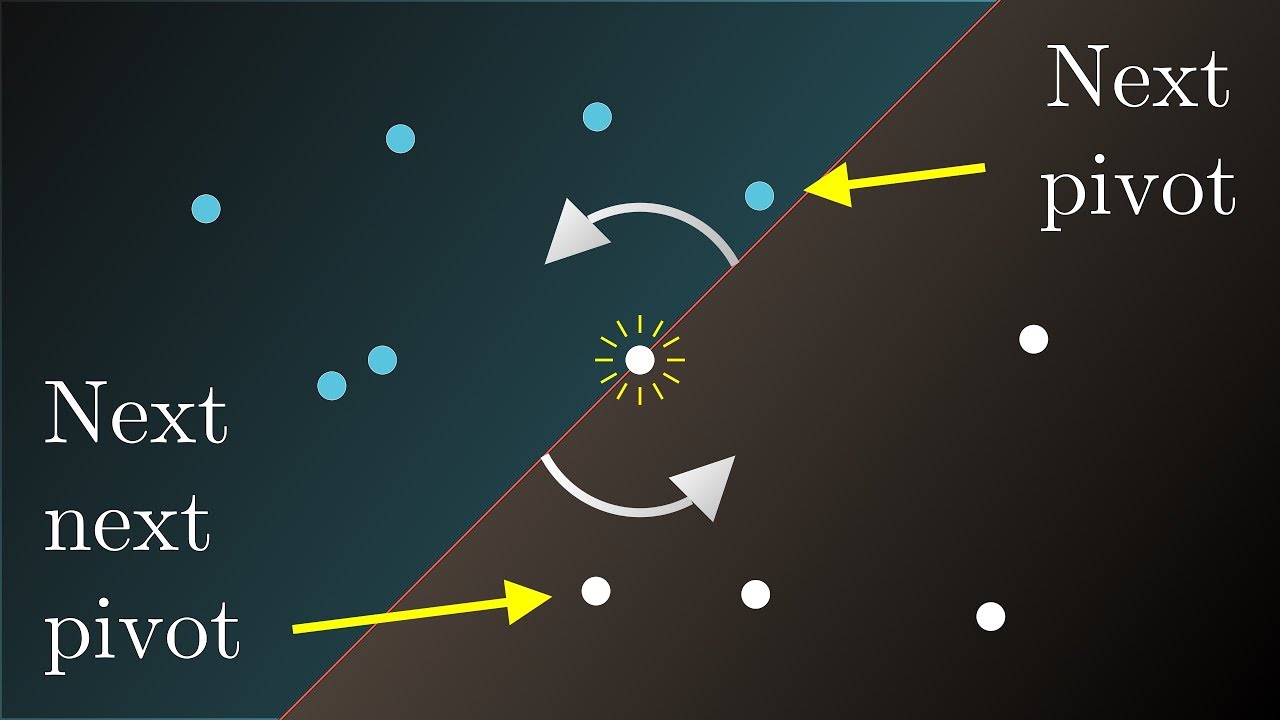
The unexpectedly hard windmill question (2011 IMO, P2)
Keywords
Summary
208 words
Critical Evaluation
Value of the Information & Strength of the Argument
The video provides a clear and rigorous explanation of a challenging mathematical problem. The argumentation is well-structured, starting with the problem statement, then building intuition through simple examples, and finally presenting a formal proof. The key insight of the invariant (the constant number of points on each side of the line) is introduced naturally and justified with a logical argument. The video also contextualizes the problem’s difficulty with real IMO statistics, which strengthens the narrative. The use of animations greatly aids in visualizing the process and making the proof accessible.
Scientific Rigor, Source Quality, Title Accuracy
The video is scientifically rigorous, with a correct and well-explained proof. It cites official IMO sources, including the official problem list and results database, which adds credibility. The title accurately reflects the content, focusing on the surprising difficulty of the problem. The video also provides links to interactive visualizations and related resources, enhancing its educational value. The adéquation between the title and content is excellent.
170 words
Title / Content Match
The title accurately reflects the content, focusing on the surprising difficulty of the 2011 IMO Problem 2.
Quality & Reliability
9/10
The video is produced by a well-known mathematics educator with a reputation for accuracy and clarity. The mathematical proof is rigorous and well-explained, and the video cites official IMO sources and provides links to further resources.
Key Moments
Markers derived by PSI from the transcript: the creator did not define chapters.
- Introduction to the IMO and the 2011 Problem 2.
- Statement of the windmill problem.
- Discussion of the problem's difficulty and statistics.
- Playing with simple cases: 2, 3, and 4 points.
- Introduction of the invariant: counting points on each side.
- Proof that the invariant is preserved during the process.
- Completing the proof for odd and even numbers of points.
- Broader lessons: social aspect and the concept of invariants.
Cited Sources
- IMO 2011 Shortlist — Official list of problems considered for the IMO 2011, including the windmill problem.
- IMO Official Website — Data for past IMO results, including participant scores.
- Interactive Windmill Visual (Reddit) — Viewer-created interactive visualization of the windmill problem.
- Interactive Windmill Visual (GitHub) — Another interactive visualization of the windmill problem.
- Minutephysics video on proper time — Referenced as an example of an invariant in physics.
- Manim library — Open-source Python library used for animations.
Concurring Sources
- IMO 2011 Shortlist — The official problem statement and solution align with the video's explanation.
- IMO Official Website — The statistics on participant scores confirm the problem's difficulty.
External References
Contribution & Novelties
The video provides a clear and accessible explanation of a notoriously difficult IMO problem, emphasizing the power of finding invariants. It goes beyond just presenting the solution by discussing the problem’s context and the broader mathematical lesson.
Pour aller plus loin :
- Invariant (mathematics) — The concept of invariants is central to the solution and is widely used in mathematics and physics.
- International Mathematical Olympiad — Background on the competition and its problems.
- Terence Tao — The video quotes Tao on the importance of mathematical puzzles; his work exemplifies the use of invariants.
93 words
Radar Profile
The radar profile shows very high scores across all dimensions, with particularly strong performance in quality of information and fiabilité. The video excels in providing accurate, well-sourced content with clear explanations, making it an excellent educational resource.
💬 Très positif. Sur les 30 commentaires analysés, le public exprime une admiration massive pour la qualité des animations et la clarté des explications, avec de nombreux commentaires humoristiques sur la difficulté du problème et la satisfaction des sons de clics.