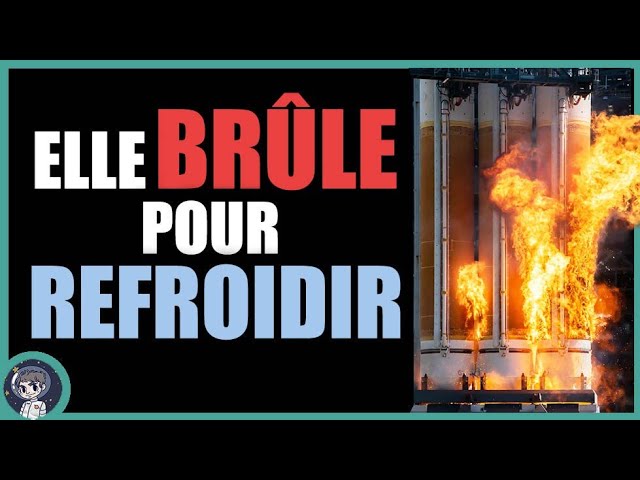
Cette fusée PREND FEU à chaque décollage ! - On Se l'Demande #37 - Le JDE
Keywords
Summary
173 words
Critical Evaluation
Value of the Information & Strength of the Argument
The video provides a clear and well-structured explanation of a complex engineering phenomenon. It effectively breaks down the cause of the fireball into a logical chain of design choices: cost reduction leading to an ablative nozzle, the use of an open cycle, and the need for a fuel-rich mixture. The argumentation is solid, connecting each step to the next. The use of visuals, such as footage of the fireball and diagrams of the engine, enhances understanding. The host also addresses potential concerns by explaining why the fireball is not dangerous, citing the Bernoulli effect and the brief duration of the event. The video successfully balances technical depth with accessibility, making it valuable for both enthusiasts and those new to rocket science.
Scientific Rigor, Source Quality, Title Accuracy
The video demonstrates strong scientific rigor. The explanation is accurate and aligns with known facts about the RS-68 engine and Delta IV rocket. The host clearly distinguishes between the RS-25’s regenerative cooling and the RS-68’s ablative approach. The description of the open-cycle engine and the stoichiometric ratio is correct. The video does not cite specific sources within the narration, but the description credits various image sources and general references like NASA. The title accurately reflects the content, and the video delivers on its promise to explain the fireball phenomenon. The adéquation between title and content is excellent.
233 words
Title / Content Match
The title accurately reflects the content, which explains why the Delta IV rocket catches fire at launch.
Quality & Reliability
8/10
The video provides a detailed and accurate explanation of the Delta IV's fireball phenomenon, grounded in engineering principles. The host clearly explains the trade-offs in engine design, the role of stoichiometry, and the ignition sequence. The information is consistent with known facts about the RS-68 engine and the Delta IV family. Minor simplifications are made for a general audience, but the core science is sound.
Chapters
- Introduction et annonces
- Un peu d'Histoire (avec un grand H)
- Les mains dans le Cambouis: RS-68. Un problème de température
- Une méthode plus simple pour les moteurs
- De réduire la température, à une énorme boule de feu
- Le fonctionnement d'un moteur à cycle ouvert: le ratio stœchiométrique.
- De l'Hydrogène qui s'accumule
- ça commence à faire beaucoup d'hydrogène tout ça....
- La conclusion qui a raté le train....
Cited Sources
- Forum de la conquête spatiale — Mentioned as a general source for space-related discussions.
- Journal de l'Espace blog — The channel's official blog, likely containing related articles.
- LabPadre YouTube channel — Credited for providing some of the footage used in the video.
- NASA Spaceflight YouTube channel — Credited for providing some of the footage used in the video.
Concurring Sources
- RS-68 - Wikipedia — Confirms the RS-68 uses an ablative nozzle and is an open-cycle engine.
- Delta IV - Wikipedia — Confirms the Delta IV family's characteristics and the fireball phenomenon.
External References
Contribution & Novelties
The video offers a clear and engaging explanation of a specific and visually striking phenomenon, making the underlying engineering principles accessible to a broad audience. It effectively connects the fireball to the engine’s design choices, such as the ablative nozzle and open-cycle architecture, providing a comprehensive understanding.
Pour aller plus loin :
- Rocket engine cycles — Overview of different engine cycles, including open and closed cycles.
- RS-68 — Detailed article on the RS-68 engine, its design, and specifications.
- Stoichiometry — Fundamental concept in chemistry relevant to the fuel-oxidizer ratio discussed.
- Bernoulli’s principle — Explains the pressure effect that draws the fireball away from the rocket.
105 words
Radar Profile
The radar profile shows high scores across all dimensions, indicating a well-rounded and reliable video. The quantity and quality of information are strong, and the technical level is appropriate for the target audience. The overall reliability is high, making this a trustworthy source for understanding the Delta IV fireball.
💬 Très positif. Sur les 30 commentaires analysés, l'immense majorité exprime un fort enthousiasme pour la vidéo, avec de nombreux demandes pour un épisode dédié aux moteurs à cycle fermé et des remerciements pour les explications claires.