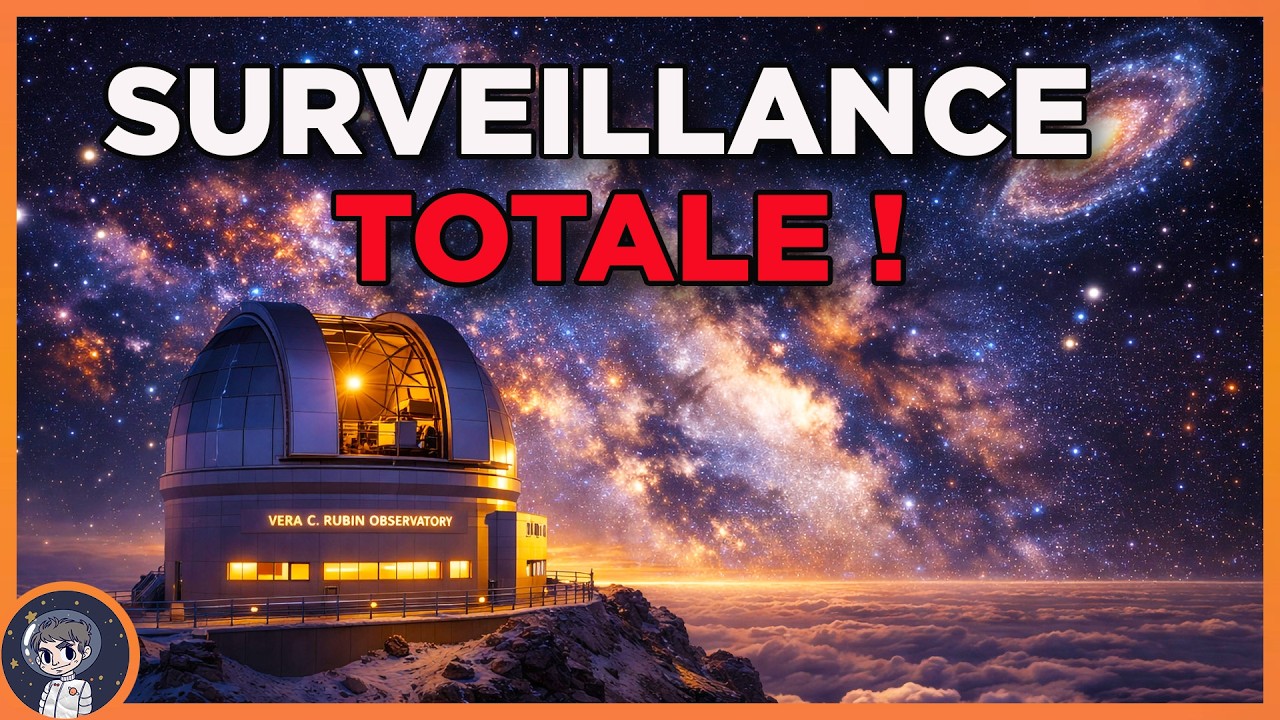
Télescope RUBIN: La Terre est enfin sous SURVEILLANCE TOTALE ! - Le Journal de l'Espace #337 - Actu
Keywords
Summary
154 words
Critical Evaluation
Value of the Information & Strength of the Argument
The video provides a good overview of recent space news, with each segment offering a mix of factual reporting and contextual explanation. The host effectively explains the significance of each event, such as why the Artemis 2 re-entry was so critical and how stellar streams can reveal dark matter. The argumentation is generally solid, though some claims, like the radiation shielding on the Moon, are presented with appropriate caution. The video also includes a sponsored segment for Incogni, which is clearly separated from the news content.
Scientific Rigor, Source Quality, Title Accuracy
The video relies on official sources like NASA, ESA, and CNSA, and the host mentions these agencies. However, specific citations are not provided in the description, and the video does not include detailed references for each story. The title is somewhat clickbait, focusing on the Rubin telescope, but the video covers multiple topics. The description includes links to the channel’s blog and social media, but no direct links to the scientific papers or press releases mentioned. Overall, the scientific rigor is acceptable for a news roundup, but it could be improved with more explicit sourcing.
196 words
Title / Content Match
The title focuses on the Rubin telescope, but the video covers multiple space news items. The Rubin segment is the last and most prominent, but the title is somewhat misleading as it suggests a single-topic video.
Quality & Reliability
7/10
The video presents a weekly space news roundup with a mix of confirmed events (Artemis 2, OSIRIS-REx results, Gaia data) and some speculative or preliminary findings (radiation protection, Rubin telescope early results). The host is generally accurate but occasionally uses sensational language. The information is up-to-date and sourced from official agencies, but the video lacks detailed citations for each claim.
Chapters
Cited Sources
- Incogni — Sponsor of the video, offering a discount on their data privacy service.
- Creative Commons License — License for the music used in the video.
- CreatorChords — Source of the music track 'Superepic' by Alexander Nakarada.
- Sound Lapse — Source of the music track 'City Walk'.
- Utho Riley — Music artist whose work is used in the video.
- Forum de la conquête spatiale — A forum mentioned as a general source for space news.
- Jamendo — Source of the music track 'Inspire Galactic' by Carvine.
- Le Journal de l'Espace Blog — The channel's blog with additional articles.
- Quentin Leicht LinkedIn — LinkedIn profile of the host.
- Scott Buckley — Music artist whose work is used in the video.
- Bensound - Evolution — Music track used in the video.
- Sound Lapse - City Walk — Music track used in the video.
Concurring Sources
- NASA Artemis II — Confirms the Artemis II mission details and its success.
- ESA Gaia — Confirms the Gaia mission's capabilities and its role in discovering stellar streams.
- Rubin Observatory — Confirms the Rubin Observatory's early operations and its potential for asteroid discovery.
Dissenting Sources
- Comment on Rubin's asteroid detection capabilities — A commenter argues that Rubin is not optimized for asteroid detection and that many early detections may be rediscoveries, suggesting the video may overstate its immediate impact.
Contribution & Novelties
The video provides a concise and accessible summary of recent space news, making complex topics like stellar streams and asteroid sample analysis understandable to a general audience. It highlights the significance of each discovery and places them in the context of ongoing space exploration efforts. The segment on the Rubin Observatory’s early asteroid discoveries is particularly timely, as it showcases the telescope’s potential before its full science operations begin.
Pour aller plus loin :
- Artemis II mission overview — Official NASA page for Artemis II, providing details on the mission and its objectives.
- OSIRIS-REx mission — NASA’s page on the OSIRIS-REx mission, including information on the Bennu samples.
- Gaia mission — ESA’s page on the Gaia satellite, which is mapping the Milky Way in 3D.
- Rubin Observatory — Official site of the Vera C. Rubin Observatory, with information on its science goals and early results.
- Chang’e 4 mission — Wikipedia article on the Chinese lunar lander, which provided radiation data.
160 words
Radar Profile
The radar profile shows high scores in quantity of information and technical level, reflecting the video's comprehensive coverage and use of technical terms. The quality and reliability scores are slightly lower, indicating that while the information is generally accurate, it lacks detailed citations and sometimes uses sensational language. The overall balance suggests a well-produced news roundup with a solid factual base but room for improvement in sourcing.
💬 Très positif. Sur les 30 commentaires analysés, la grande majorité exprime des remerciements et des éloges pour la qualité de l'information et la clarté des explications, avec quelques questions techniques et un commentaire critique sur les capacités du télescope Rubin.