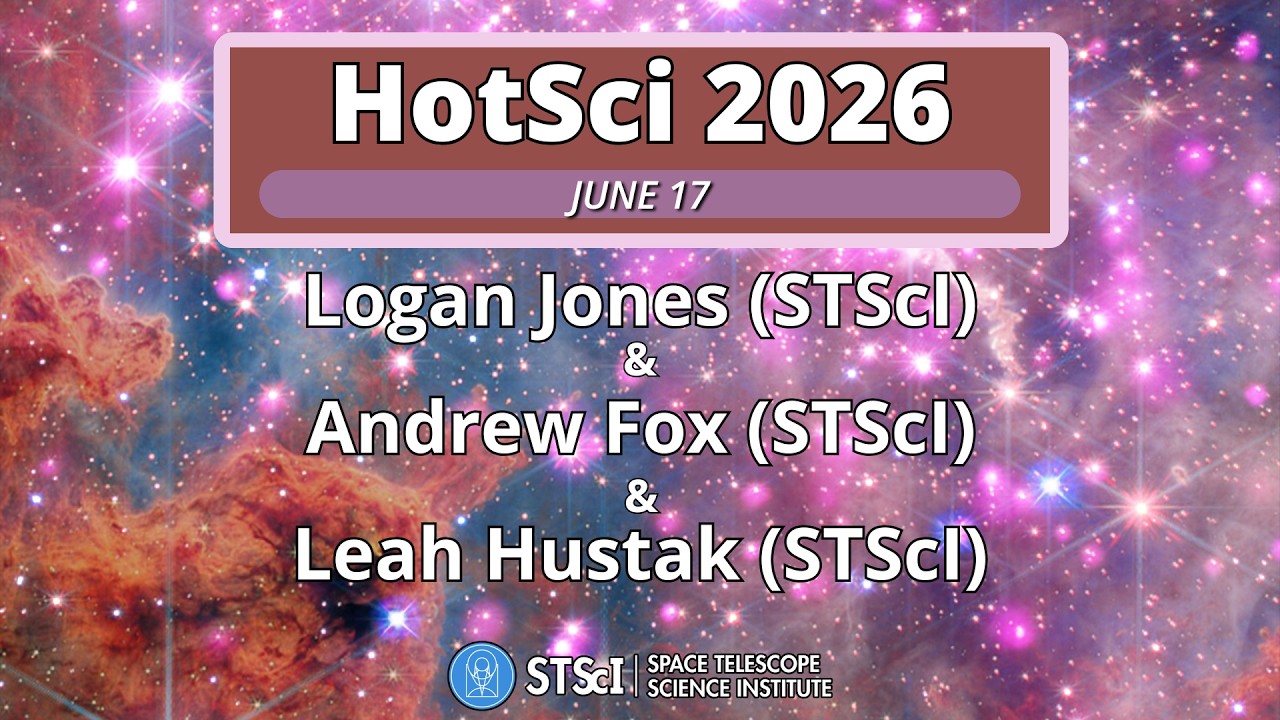
STScI/JHU 2026 HotSci Series -- June 17th
Keywords
Summary
175 words
Critical Evaluation
Value of the Information & Strength of the Argument
The talks provide valuable insights into current astrophysical research. Jones’s presentation offers a detailed look at the methodology for analyzing PAH emission in a nearby galaxy, including the handling of continuum subtraction and contamination issues. The argumentation is based on observational data and references to existing models. Fox’s talk presents a compelling case for Cloud-9 as a dark matter minihalo, supported by theoretical predictions and multi-telescope observations. The reasoning is clear and well-structured. Hustak’s talk is more descriptive, focusing on the visualization process, but still provides useful information about the technical workflows involved.
Scientific Rigor, Source Quality, Title Accuracy
The talks are given by researchers at STScI, a reputable institution, and reference specific observational programs and data. The scientific content appears rigorous, though the results are preliminary and not yet peer-reviewed. The title accurately reflects the content, which is a series of scientific talks. No external sources are cited in the video itself, but the description provides context for the talks.
170 words
Title / Content Match
The title accurately describes the content: a series of three scientific talks presented at the STScI/JHU HotSci series on June 17th.
Quality & Reliability
8/10
Talks by researchers at STScI presenting preliminary results from JWST and other observatories, with references to specific programs and data. The content is technical and appears scientifically sound, though not peer-reviewed at this stage.
Key Moments
Markers derived by PSI from the transcript: the creator did not define chapters.
- Introduction and start of the first talk by Logan Jones on PAHs in M101.
- Jones discusses the importance of PAHs and the metallicity dependence.
- Jones presents JWST imaging of M101 and preliminary PAH feature maps.
- Jones discusses the challenges with NGC 5471 and sulfur line contamination.
- End of first talk and start of second talk by Andrew Fox on dark matter minihalos.
- Fox explains the theoretical predictions for RELHICs.
- Fox presents observations of Cloud-9 and its properties.
- Start of third talk by Leah Hustak on 3D visualization of the Pillars of Creation.
- Hustak discusses the technical process of creating the 3D visualization.
Cited Sources
- JWST NIRCam and MIRI observations of M101 — Referenced in the first talk as the source of the imaging data for the PAH study.
- FAST telescope discovery of Cloud-9 — Referenced in the second talk as the initial discovery of the H I cloud.
- Hubble and Webb observations of the Pillars of Creation — Referenced in the third talk as the basis for the 3D visualization.
Concurring Sources
- JWST observations of PAH emission in low-metallicity galaxies — Supports the finding that PAHs can exist in low-metallicity environments.
- Simulations of dark matter minihalos — Provides theoretical predictions for RELHICs that match the observed properties of Cloud-9.
Dissenting Sources
- Alternative explanations for compact H I clouds — Some studies suggest that compact H I clouds could be tidal debris rather than dark matter halos.
Contribution & Novelties
The video provides a unique glimpse into ongoing research at STScI, showcasing preliminary results that are not yet published. The first talk offers new insights into PAH behavior in a low-metallicity environment, potentially challenging existing models. The second talk presents a strong candidate for a dark matter minihalo, which is a significant finding if confirmed. The third talk highlights the value of multiwavelength data for creating educational visualizations.
Pour aller plus loin :
- Polycyclic aromatic hydrocarbon — Background on PAHs and their astrophysical significance.
- Lambda-CDM model — The cosmological model underlying the dark matter predictions.
- Pillars of Creation — Context for the 3D visualization.
104 words
Radar Profile
The radar profile shows high scores across all dimensions, indicating a technically dense and reliable presentation. The talks are well-structured and provide substantial information, though the preliminary nature of the results slightly reduces the overall reliability score.