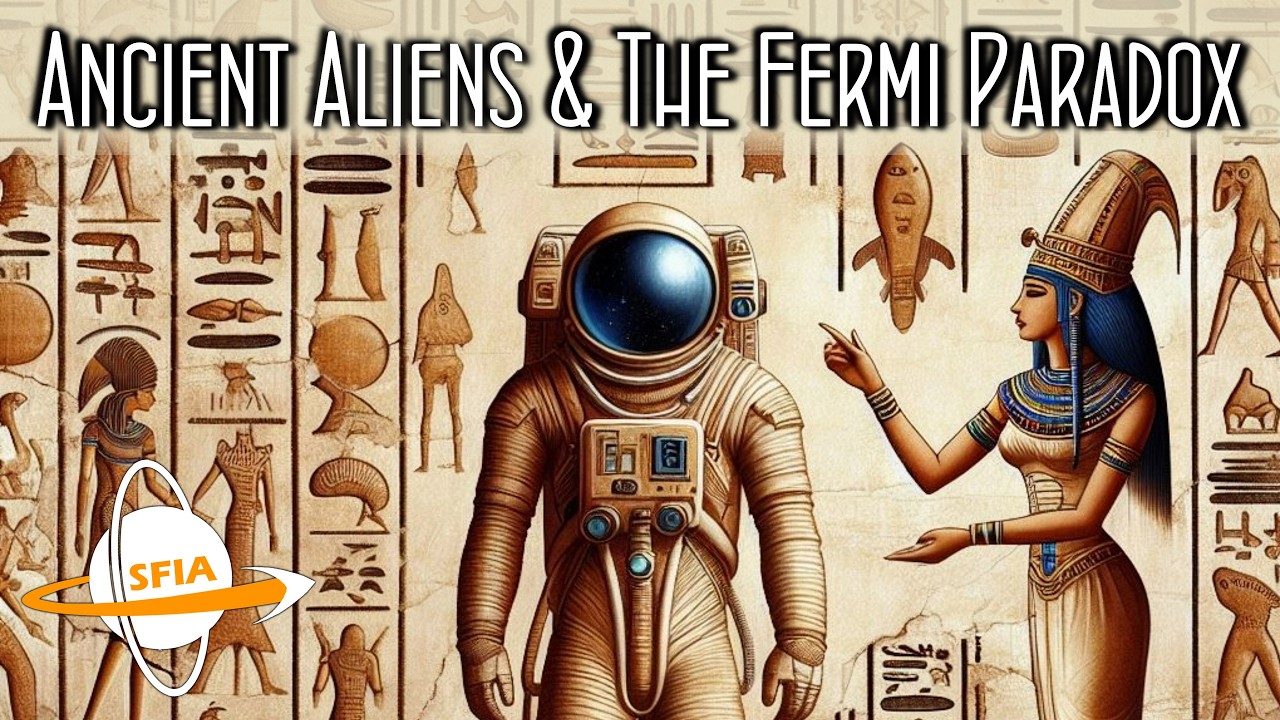
Ancient Aliens & the Fermi Paradox
Keywords
Summary
183 words
Critical Evaluation
Value of the Information & Strength of the Argument
The video provides substantial value by systematically deconstructing the ancient aliens hypothesis with logical rigor. Arthur argues that the Fermi Paradox is not a true paradox but a problem with proposed solutions. He effectively uses the concept of non-exclusivity to show that many solutions are flawed because they rely on universal behaviors. The argument that advanced civilizations would likely be curious and thus visit or study primitive life is compelling, supported by the idea that even a tiny fraction of a K2 civilization’s population would constitute billions of curious individuals. He also addresses the ‘Dyson Dilemma’ and the problem of motivation, noting that solutions based on specific ideologies are dubious. The discussion of falsifiability is particularly strong, as Arthur points out that many ancient alien claims cannot be tested, making them scientifically weak. He also highlights the tendency for theories to persist despite contradictory evidence, using the Orion Correlation Theory as an example. The argumentation is well-structured, moving from general principles to specific examples, and maintains a balanced tone, acknowledging the plausibility of some ideas while dismissing others based on evidence.
Scientific Rigor, Source Quality, Title Accuracy
The video demonstrates high scientific rigor. Arthur references specific scientific missions, such as Rosetta and Stardust, and discusses the implications of glycine detection. He also mentions the precession of the equinoxes and its effect on astronomical alignments, showing an understanding of the scientific method. The sources cited in the description are primarily the channel’s own website and social media, as well as music credits, which are not directly related to the content. However, the video’s internal references to scientific concepts are accurate and well-explained. The title accurately reflects the content, which directly addresses the ancient aliens hypothesis within the Fermi Paradox framework. The video does not overstate claims and clearly distinguishes between speculation and evidence-based reasoning. The lack of external citations in the description is a minor weakness, but the video’s internal rigor compensates for this.
332 words
Title / Content Match
The title accurately reflects the content, which directly addresses the ancient aliens hypothesis as a potential solution to the Fermi Paradox.
Quality & Reliability
8/10
The video presents a rigorous, scientifically grounded analysis of the ancient aliens hypothesis within the Fermi Paradox framework. Isaac Arthur systematically evaluates evidence, discusses falsifiability, and references scientific findings (e.g., Rosetta mission glycine detection). The content is well-structured and avoids sensationalism, though it remains a popular science presentation rather than a peer-reviewed source.
Key Moments
Markers derived by PSI from the transcript: the creator did not define chapters.
- Introduction to the Fermi Paradox and its four main solution categories.
- Discussion of panspermia and the Rosetta mission's detection of glycine.
- Explanation of why advanced civilizations would likely be curious and visit primitive life.
- Critique of the Orion Correlation Theory and the Sphinx erosion hypothesis.
- Discussion of the 'uplift' concept and David Brin's Uplift Saga.
- Analysis of why ancient alien theories persist despite lack of evidence.
- Conclusion summarizing the strengths and weaknesses of the ancient aliens hypothesis.
Cited Sources
- Isaac Arthur's Website — Official website of the channel, providing additional resources and episodes.
- Nebula — Streaming platform where Isaac Arthur's content is available.
- Soundcloud - Episode Audio — Audio-only version of the episode.
- Soundcloud - Narration Only — Narration-only version of the episode.
- Reddit - r/IsaacArthur — Community discussion forum for the channel.
- Subscribestar — Platform for supporting Isaac Arthur's work.
Concurring Sources
- Fermi Paradox - Wikipedia — Provides background on the paradox and various proposed solutions, aligning with the video's framework.
- Panspermia - Wikipedia — Discusses the hypothesis that life originated elsewhere and was transported to Earth, supporting the video's discussion.
Dissenting Sources
- Ancient Aliens - History Channel — The History Channel's series often promotes the ancient aliens hypothesis without scientific rigor, contrasting with the video's critical approach.
External References
Contribution & Novelties
The video provides a fresh perspective on the ancient aliens hypothesis by integrating it into the Fermi Paradox framework and applying logical rigor. It challenges common assumptions and emphasizes the importance of falsifiability. The discussion of the ‘uplift’ concept as a plausible model for ancient alien influence is particularly novel. The video also highlights the tendency for theories to persist despite contradictory evidence, offering a psychological explanation for this phenomenon.
Pour aller plus loin :
- Fermi Paradox — Overview of the paradox and proposed solutions.
- Panspermia — Hypothesis that life exists throughout the Universe and is distributed by space dust, meteoroids, etc.
- Kardashev Scale — Method of measuring a civilization’s level of technological advancement based on energy usage.
- Orion Correlation Theory — A fringe theory linking the Giza pyramids to Orion’s Belt.
- Precession of the Equinoxes — The slow shift in Earth’s rotational axis affecting astronomical alignments.
147 words
Radar Profile
The radar profile shows high scores in information quantity, quality, and technical level, with a slightly lower but still strong reliability score. This indicates a well-researched, technically detailed, and reliable video, though it remains a popular science presentation rather than a peer-reviewed source.
💬 Très positif. Sur les 30 commentaires analysés, la grande majorité exprime une forte appréciation, louant la rigueur scientifique, l'humour et la profondeur du contenu, tout en critiquant les théories du complot.