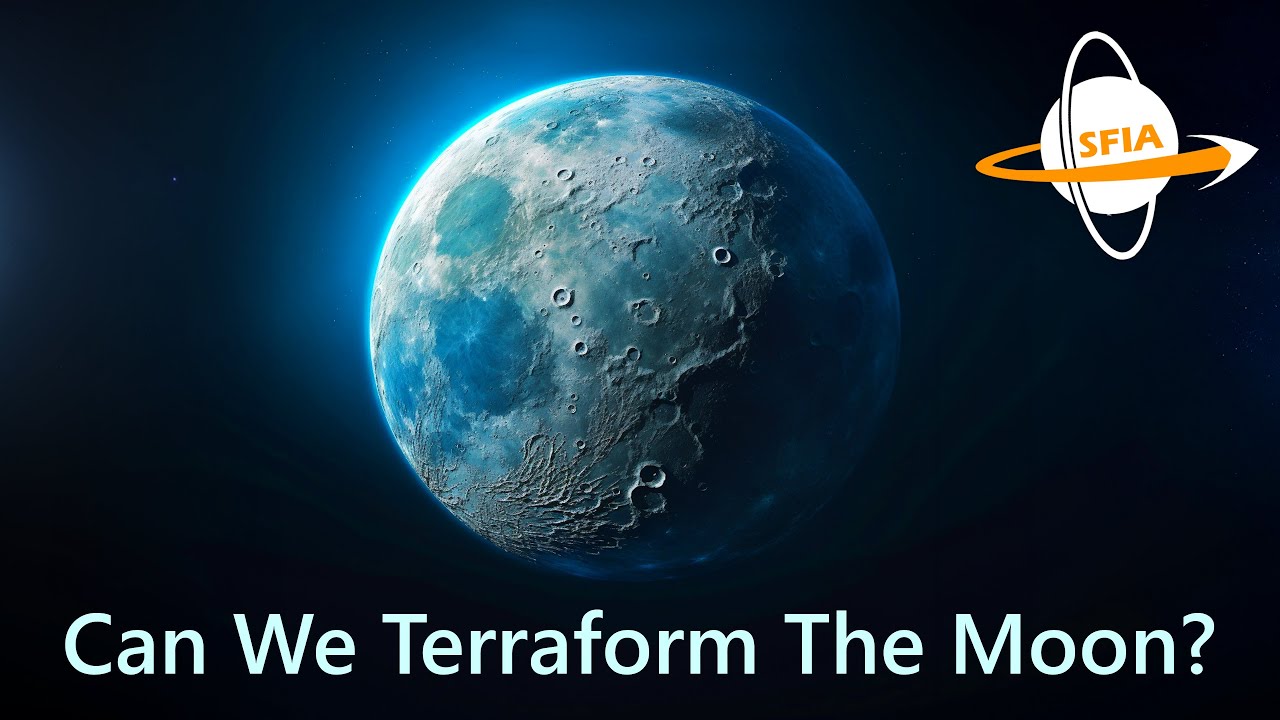
Can We Terraform The Moon?
Keywords
Summary
138 words
Critical Evaluation
Value of the Information & Strength of the Argument
The video provides substantial value by systematically breaking down a complex topic into manageable components: atmospheric retention, rotation, gravity, and magnetosphere. It offers a balanced view, presenting both the feasibility and the practical hurdles. The argumentation is solid, using physics principles (escape velocity, rotational energy) and engineering concepts (orbital rings, mass drivers) to support claims. Arthur also introduces nuanced ideas like piggybacking terraforming efforts on existing industrial operations and the potential for bioforming to mitigate low-gravity effects. The discussion of para-terraforming’s vulnerability versus terraforming’s permanence adds depth. The reasoning is logical and well-structured, though inherently speculative due to the futuristic nature of the topic.
Scientific Rigor, Source Quality, Title Accuracy
The video demonstrates scientific rigor by grounding its discussion in established physics and referencing other episodes in the series for detailed explanations (e.g., magnetosphere for Mars, domes of Mars). It avoids unsubstantiated claims, clearly labeling speculative technologies as such. The title accurately reflects the content, which is a comprehensive exploration of the question. The description provides links to the channel’s website, Patreon, and social media, but no direct citations to academic papers or external sources. The video’s credibility relies on the creator’s established expertise and the internal consistency of the arguments.
210 words
Title / Content Match
The title accurately reflects the content, which thoroughly explores the feasibility, methods, and challenges of terraforming the Moon.
Quality & Reliability
8/10
The video presents a well-structured, technically informed discussion of terraforming the Moon, grounded in established physics and engineering concepts. Isaac Arthur is a known science communicator with a track record of rigorous content. The episode is part of a series and references other episodes for deeper dives, indicating a coherent knowledge base. While speculative, the claims are clearly framed as possibilities and are internally consistent.
Key Moments
Markers derived by PSI from the transcript: the creator did not define chapters.
- Introduction to terraforming concepts: terraforming, para-terraforming, and bioforming.
- Discussion of the Moon's advantages: proximity, low gravity, and sunlight.
- Challenges: atmospheric loss due to low gravity and lack of magnetosphere.
- Solutions for atmosphere: artificial magnetosphere and domes.
- Adjusting the Moon's rotation to a 24-hour day using mass drivers and orbital rings.
- Potential to add mass to the Moon using artificial black holes for higher gravity.
- Conclusion: the Moon will likely be the first terraformed body, using a mix of approaches.
Cited Sources
- Isaac Arthur Website — Official website for the channel, providing additional resources and episodes.
- Nebula — Streaming platform where Isaac Arthur's content is available.
- Reddit Community — Community forum for discussions about the channel's content.
- Subscribestar — Platform for supporting the creator.
- Epidemic Sound — Music licensing service used for the video's soundtrack.
Concurring Sources
- Terraforming of Mars — Discusses similar challenges and methods for Mars, which are often compared to the Moon.
- Space colonization — Provides context on the broader goals and challenges of settling other worlds.
Contribution & Novelties
The video offers a comprehensive and accessible synthesis of terraforming the Moon, integrating concepts like artificial magnetospheres, orbital rings, and bioforming into a coherent framework. It uniquely emphasizes the pragmatic approach of combining terraforming, para-terraforming, and bioforming, and highlights the Moon’s potential as the first terraformed body due to its proximity and industrial advantages. The discussion of piggybacking terraforming efforts on existing projects is a novel perspective.
Pour aller plus loin :
- Terraforming — Provides a broad overview of the concept and its challenges.
- Paraterraforming — Explores the concept of enclosed habitats as an alternative to full terraforming.
- Artificial magnetosphere — Discusses the concept of creating a magnetic field to protect a planet’s atmosphere.
- Orbital ring — A megastructure concept that could be used for various purposes, including rotation adjustment.
130 words
Radar Profile
The radar profile shows high scores in quantity of information and technical level, indicating a dense and detailed presentation. The quality and reliability scores are also strong, reflecting the creator's expertise and the logical structure. The overall profile suggests a highly informative and credible video, with a slight emphasis on breadth over depth in some areas.
💬 Très positif. Sur les 30 commentaires analysés, l'écrasante majorité exprime enthousiasme et soutien, avec des éloges pour la qualité du contenu et l'optimisme qu'il inspire, ainsi que des discussions constructives sur les concepts présentés.