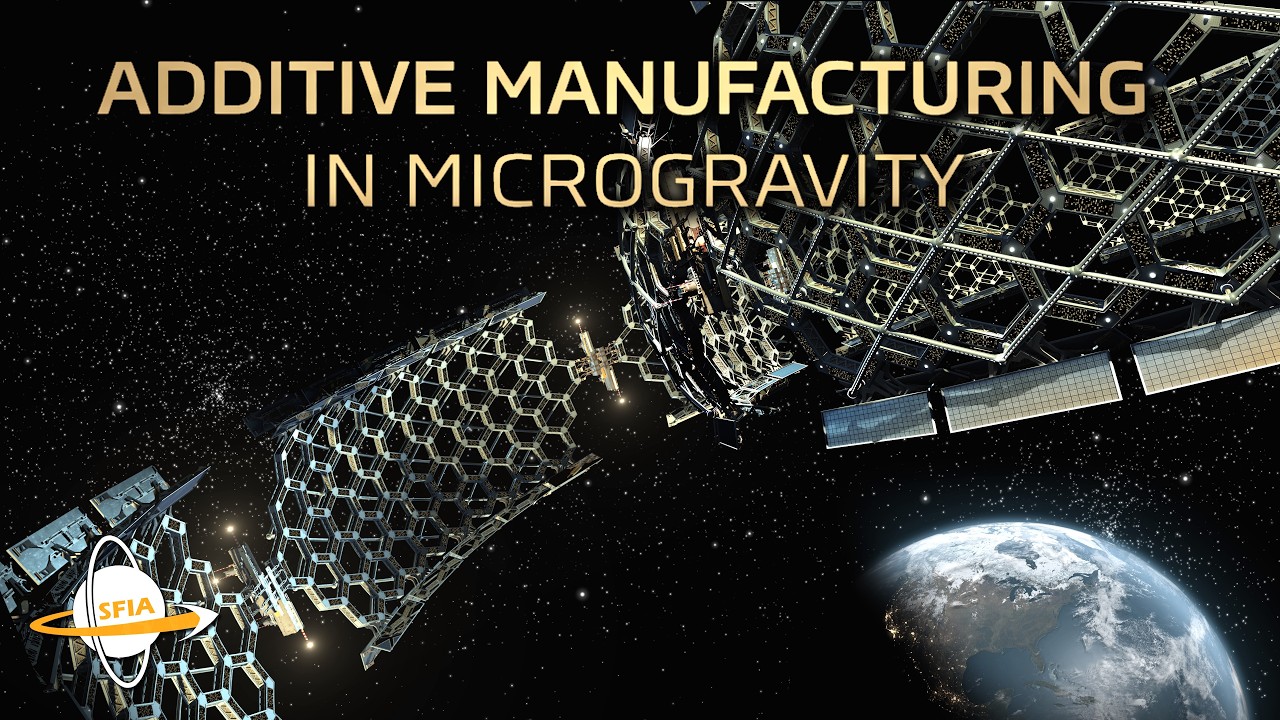
Additive Manufacturing in Microgravity
Keywords
Summary
178 words
Critical Evaluation
Value of the Information & Strength of the Argument
The video provides substantial value by clearly articulating the paradigm shift from launching finished objects to launching manufacturing capability. It effectively argues that AM’s primary benefit in space is logistical, not magical, by reducing the need for pre-launched spare parts and enabling in-situ resource utilization. The argumentation is solid, grounded in physical principles and practical engineering considerations. It systematically addresses both the advantages (complexity is cheap, de-massing, enabling large-scale construction) and the challenges (thermal management, material behavior in microgravity, dust in low gravity). The video avoids overhyping the technology, explicitly stating that it won’t replace traditional industry and that self-replicating factories remain science fiction. The reasoning is coherent and builds logically from basic concepts to future applications, making a compelling case for the importance of AM in space exploration.
Scientific Rigor, Source Quality, Title Accuracy
The video demonstrates scientific rigor by accurately describing the physical challenges of microgravity manufacturing, such as the role of surface tension and the absence of convection, which are well-established in materials science. It references specific examples like ZBLAN optical fibers and bioprinting, which are active areas of research. The quality of sources is moderate; while the video does not cite specific academic papers, it aligns with publicly known research and concepts like SpiderFab and ISRU. The title accurately reflects the content, which is a focused discussion on additive manufacturing in microgravity. The video is a science communication piece rather than a peer-reviewed study, but it maintains a high standard of accuracy and avoids sensationalism.
258 words
Title / Content Match
The title accurately reflects the content, which focuses on the application of additive manufacturing in microgravity environments, discussing both its potential and its limitations.
Quality & Reliability
8/10
The video provides a well-structured, technically accurate overview of additive manufacturing in space, grounded in established physics and engineering principles. It clearly distinguishes between science fiction and realistic capabilities, and appropriately highlights challenges such as thermal management and material behavior in microgravity. The content is consistent with current research and expert knowledge in the field.
Chapters
Cited Sources
- Isaac Arthur's Website — Official website of the channel, providing additional resources and information.
- Nebula - Settling Saturn's Rings — Exclusive video on Nebula, mentioned as a related topic on megastructures.
- Nebula - The Anatomy of the Nokia 3310 — Exclusive video on Nebula, used as an example of engineering analysis.
- Reddit Community — Community forum for discussion of the channel's content.
- Subscribestar — Platform for supporting the channel.
Concurring Sources
- NASA - In-Space Manufacturing — NASA's research on additive manufacturing in microgravity aligns with the video's claims about the challenges and potential of the technology.
- ESA - 3D Printing in Space — ESA's work on 3D printing in space supports the video's discussion of using local materials and manufacturing components on demand.
Dissenting Sources
- No direct discordant sources found — The video's content is consistent with current scientific understanding and engineering proposals. No credible sources contradict its main claims.
External References
Contribution & Novelties
The video provides a comprehensive and accessible synthesis of the current state and future potential of additive manufacturing in space. Its original contribution lies in framing AM not as a replicator but as a logistical tool that shifts the bottleneck from mass to capability. It effectively bridges the gap between theoretical concepts and practical engineering challenges, offering a nuanced view that is often missing in popular discussions. The discussion of the ‘messy middle’ of low gravity and the concept of ‘bootstrapping’ manufacturing capability are particularly insightful.
Pour aller plus loin :
- In-situ resource utilization — Key concept for using local materials in space, central to the video’s discussion of regolith-based manufacturing.
- ZBLAN — A type of fluoride glass that benefits from microgravity manufacturing, as mentioned in the video.
- SpiderFab — A concept for robotic in-space manufacturing of large structures, directly relevant to the video’s discussion of large-scale construction.
- Microgravity — The environment that defines the challenges and opportunities discussed in the video.
162 words
Radar Profile
The radar profile shows a balanced video with high scores across all dimensions. The quantity and quality of information are strong, and the technical level is appropriate for an informed audience. The reliability is high, reflecting the video's grounded approach. The overall profile indicates a well-rounded and trustworthy science communication piece.
💬 Très positif. Sur les 30 commentaires analysés, l'écrasante majorité exprime un enthousiasme marqué pour le contenu, saluant la clarté de l'explication, la pertinence du sujet et la qualité de la narration, avec quelques remarques humoristiques et des remerciements pour le travail de la chaîne.