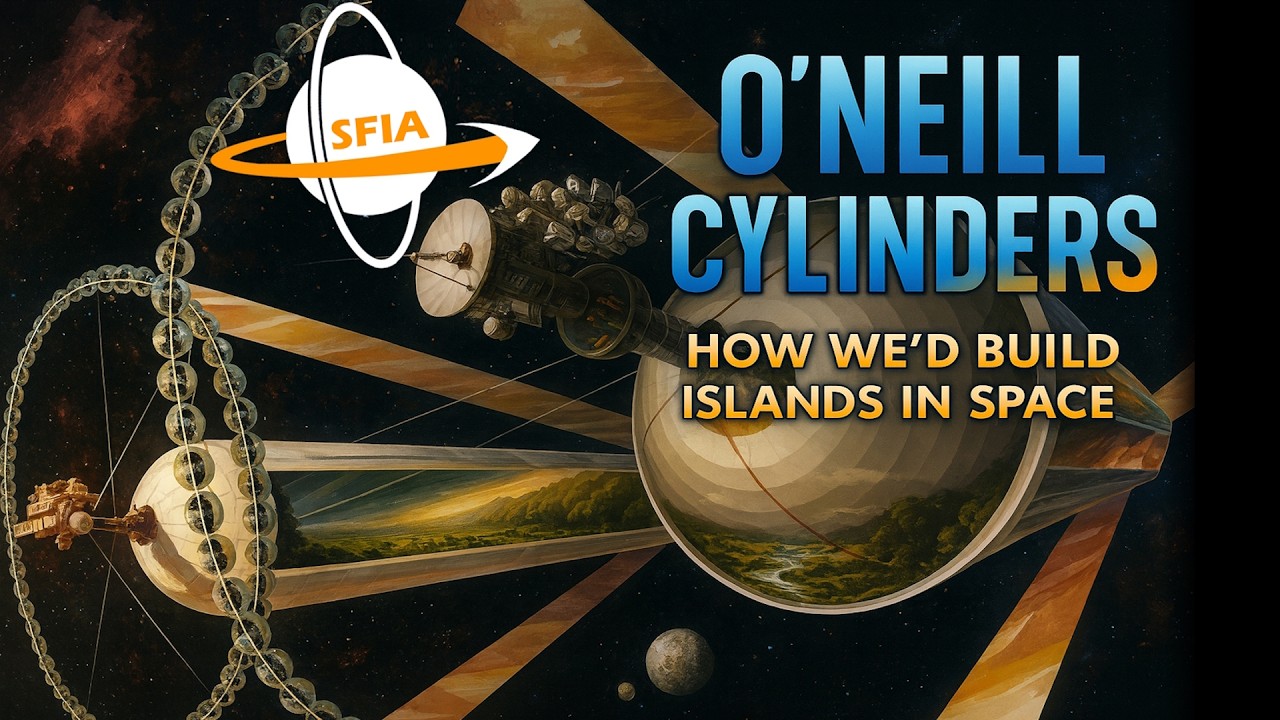
O’Neill Cylinders — How We’d Build Islands in Space
Keywords
Summary
162 words
Critical Evaluation
Value of the Information & Strength of the Argument
The video offers substantial value by synthesizing a wide range of technical and conceptual information about O’Neill cylinders. It goes beyond a simple overview, delving into engineering details such as material strength, radiation shielding thickness, and mass estimates. The argumentation is solid, logically progressing from basic principles to more complex applications and future scenarios. Arthur effectively uses analogies (skyscrapers, log cabins) to contextualize the development timeline. He also presents multiple perspectives on design choices (e.g., windows vs. end-cap lighting, soil vs. hydroponics) and acknowledges uncertainties, which strengthens the credibility of the presentation. The inclusion of economic and societal implications adds depth, making a compelling case for the viability and transformative potential of space habitats.
Scientific Rigor, Source Quality, Title Accuracy
The video demonstrates strong scientific rigor, referencing the foundational work of Gerard K. O’Neill and the Island 3 design. It also mentions related concepts like Stanford Torus, Bernal Sphere, and McKendree cylinders, showing a good grasp of the existing literature. While the video does not cite specific academic papers, it is consistent with established knowledge in space habitat engineering. The title accurately reflects the content, which is a comprehensive exploration of O’Neill cylinders. The presentation is well-structured and avoids sensationalism, instead offering a reasoned and balanced analysis. The creator’s role as president of the National Space Society adds to the authority of the content. No significant discrepancies between the title and the actual content were noted.
245 words
Title / Content Match
The title accurately reflects the content: a comprehensive exploration of O'Neill cylinder design, construction, and implications.
Quality & Reliability
8/10
The video is a well-structured, technically detailed explanation of O'Neill cylinder design, grounded in established concepts from Gerard K. O'Neill and subsequent space habitat literature. The presenter, Isaac Arthur, is president of the National Space Society, lending credibility. The content is consistent with known engineering principles, though it includes speculative future scenarios clearly framed as such.
Key Moments
Markers derived by PSI from the transcript: the creator did not define chapters.
- Introduction to space habitats and Gerard K. O'Neill's vision.
- Explanation of the basic design of an O'Neill cylinder and spin gravity.
- Discussion on radiation shielding, using soil and water.
- Materials for construction: steel, aluminum, and graphene super laminate.
- Cost and timeline estimates, comparing to skyscrapers and log cabins.
- Land area calculations and comparisons to Earth regions.
- Agricultural habitats and the role of mirrors for lighting.
- Advanced concepts: McKendree cylinders, Banks orbitals, and interstellar travel.
Cited Sources
- Isaac Arthur's Website — Official website for the channel and additional resources.
- Nebula - Post-Consciousness Civilizations — Exclusive video mentioned in the episode, related to self-sustaining habitats.
- Nebula Subscription — Link to subscribe to Nebula, mentioned for early access and exclusive content.
- Nebula Lifetime Membership — Link for a lifetime membership to Nebula.
- Reddit - r/IsaacArthur — Community discussion forum for the channel.
- Subscribestar — Platform for supporting the creator.
Concurring Sources
- O'Neill cylinder - Wikipedia — Provides a general overview that aligns with the video's description of the design.
- Space habitat - Wikipedia — Discusses various habitat designs, including O'Neill cylinders, and their feasibility.
Dissenting Sources
- No specific discordant sources found — The video's content is largely consistent with mainstream scientific and engineering discussions on space habitats. No major contradictions were identified.
External References
Contribution & Novelties
The video provides a comprehensive and up-to-date synthesis of O’Neill cylinder concepts, integrating recent developments in materials science (graphene super laminate) and automation. It offers a nuanced perspective on the timeline and necessity of such habitats, arguing they are not a near-term solution but a long-term goal. The discussion of mobile habitats as a solution to territorial disputes is a novel and thought-provoking angle. The video also clarifies common misconceptions about radiation shielding and agricultural production in space.
Pour aller plus loin :
- O’Neill cylinder - Wikipedia — Detailed overview of the concept and its history.
- Gerard K. O’Neill - Wikipedia — Biography of the physicist who proposed the design.
- Space habitat - Wikipedia — General article on space habitats, including various designs.
- McKendree cylinder - Wikipedia — Information on the larger variant of the O’Neill cylinder.
- The High Frontier - Wikipedia — O’Neill’s influential book that popularized space habitats.
150 words
Radar Profile
The radar profile shows high scores in information quantity and technical level, indicating a dense and detailed presentation. The quality and reliability scores are also strong, reflecting the presenter's expertise and the use of established concepts. The overall balance suggests a highly informative and credible video, with a slight emphasis on breadth of information over deep technical derivation.
💬 Très positif. Sur les 30 commentaires analysés, l'enthousiasme est dominant, avec de nombreuses références à la science-fiction (Gundam) et des réflexions sur les implications pratiques et philosophiques des habitats spatiaux.