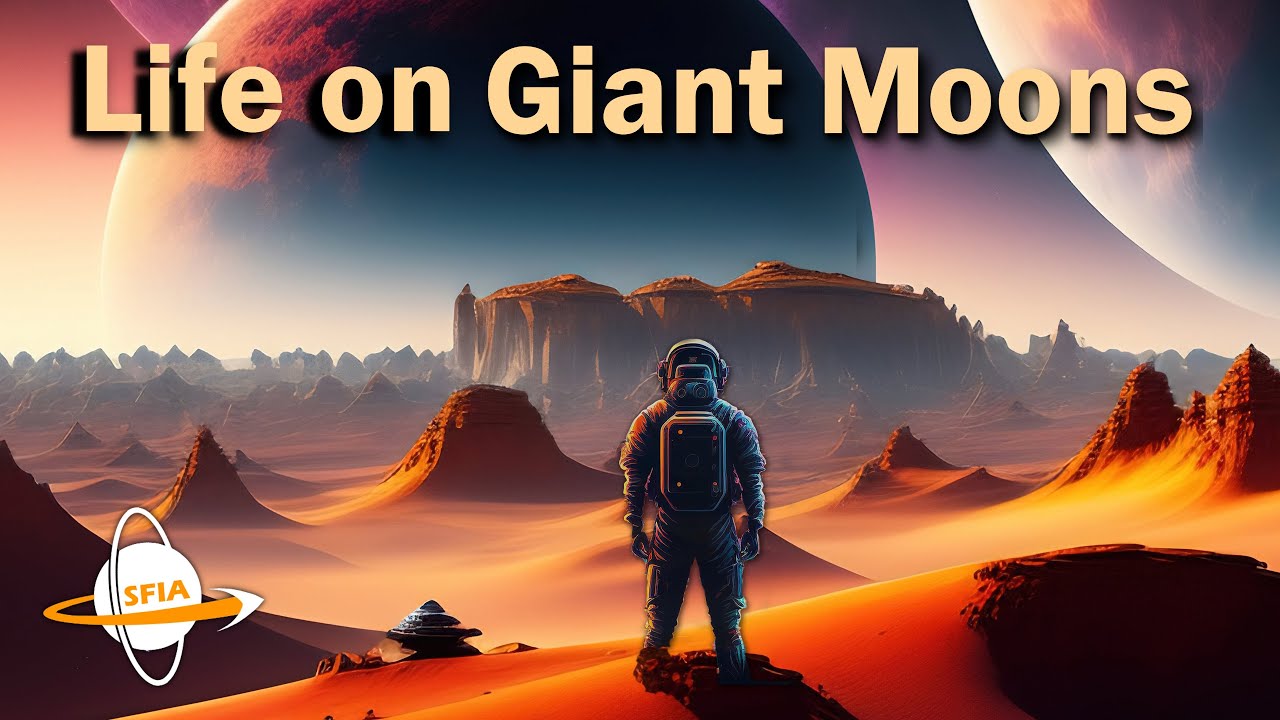
Life on Giant Moons
Keywords
Summary
174 words
Critical Evaluation
Value of the Information & Strength of the Argument
The video provides substantial value by synthesizing known astronomical principles—such as tidal locking, orbital resonances, and the stability of satellite orbits—into coherent speculative scenarios. Arthur’s argumentation is logically structured: he establishes physical constraints, applies them to fictional and hypothetical worlds, and then extrapolates to plausible outcomes for life and civilization. He is careful to flag when he is speculating, and he grounds his scenarios in real science, such as the 1/9 orbital stability rule and the effects of tidal heating on Io. The exploration of two contrasting hypothetical moons (Njord and Jill) effectively illustrates how different planetary environments could shape the development of life and technology. The discussion of cultural impacts, such as the inner/outer hemisphere divide on Njord, adds depth and demonstrates a thorough consideration of the implications.
Scientific Rigor, Source Quality, Title Accuracy
The video demonstrates scientific rigor by consistently referencing established concepts in astronomy and planetary science, such as tidal locking, orbital resonances, and the characteristics of brown dwarfs. Arthur also cites specific real-world examples like Jupiter’s moons and the exoplanet detection methods. However, he does not provide direct citations to scientific papers or external sources within the video itself, relying instead on his own expertise and general knowledge. The description includes links to his website, Patreon, and other social media, but no specific scientific references. The title accurately reflects the content, which is a speculative but scientifically informed exploration of life on giant moons. The video’s speculative nature is clearly communicated, and it does not overstate certainty, maintaining a clear distinction between established science and imaginative extrapolation.
270 words
Title / Content Match
The title accurately reflects the content, which explores the potential for life on large moons orbiting gas giants and brown dwarfs, including both natural habitability and human colonization prospects.
Quality & Reliability
8/10
The video is a well-structured speculative science communication piece, grounded in known orbital mechanics, tidal heating, and exoplanet detection methods. Isaac Arthur consistently distinguishes between established science and speculative extrapolation, and uses plausible physical constraints (e.g., orbital stability, tidal locking) to frame his scenarios. The content is internally consistent and aligns with current scientific understanding, though it intentionally ventures into speculative territory.
Key Moments
Markers derived by PSI from the transcript: the creator did not define chapters.
- Introduction to the concept of exomoons and the question of life on them.
- Discussion of the differences between moons and planets, including tidal locking and day length.
- Analysis of the fictional moon Endor, using it to illustrate orbital mechanics and habitability constraints.
- Exploration of the potential for life on moons with long day lengths and tidal heating, referencing Warhammer 40k's Colchis.
- Discussion of libration and its effects on the view of the planet from a tidally locked moon.
- Introduction of the hypothetical double planet Njord and Skadi, detailing their characteristics and the civilization on Njord.
- Introduction of the hypothetical moon Jill orbiting the brown dwarf Tarter, and the civilization that arises there.
- Conclusion summarizing the potential for life on giant moons and the implications for space exploration.
Cited Sources
- Isaac Arthur Website — Official website of the channel, providing additional resources and information.
- Nebula — Streaming platform where Isaac Arthur's content is available, often with additional episodes.
- Reddit Community — Community forum for discussions about the channel's content.
- Subscribestar — Platform for supporting Isaac Arthur's work.
Concurring Sources
- Exomoon - Wikipedia — Provides background on exomoons, supporting the video's premise that they are plausible targets for life.
- Tidal heating - Wikipedia — Explains the mechanism of tidal heating, which the video identifies as a key energy source for life on moons.
Contribution & Novelties
The video’s original contribution lies in its systematic exploration of the habitability of large moons, moving beyond simple comparisons to Earth to consider the specific physical and cultural implications of living on a tidally locked moon. It introduces two detailed hypothetical worlds (Njord and Jill) that serve as thought experiments for how life and civilization might develop under such conditions, offering a fresh perspective on the search for habitable worlds beyond the traditional ‘Earth-like planet’ paradigm. The discussion of the psychological and cultural impacts of a sky dominated by a giant planet is particularly novel.
Pour aller plus loin :
- Exomoon - Wikipedia — Provides an overview of the scientific study of exomoons, including detection methods and known candidates.
- Tidal locking - Wikipedia — Explains the phenomenon of tidal locking, which is central to the video’s discussion of moon habitability.
- Brown dwarf - Wikipedia — Details the characteristics of brown dwarfs, which are featured in the video’s hypothetical scenarios.
- Habitability of natural satellites - Wikipedia — Discusses the scientific considerations for life on moons, complementing the video’s speculative approach.
179 words
Radar Profile
The radar profile shows high scores in quantity of information and technical level, reflecting the video's dense, science-rich content. The quality and reliability scores are also strong, indicating that the information is well-presented and grounded in established science. The overall profile suggests a highly informative and technically detailed video that maintains scientific credibility.
💬 Très positif. Sur les 30 commentaires analysés, les spectateurs expriment une admiration enthousiaste pour la créativité et la rigueur scientifique de l'épisode, avec des discussions approfondies sur les concepts présentés et des suggestions de scénarios de science-fiction inspirés.