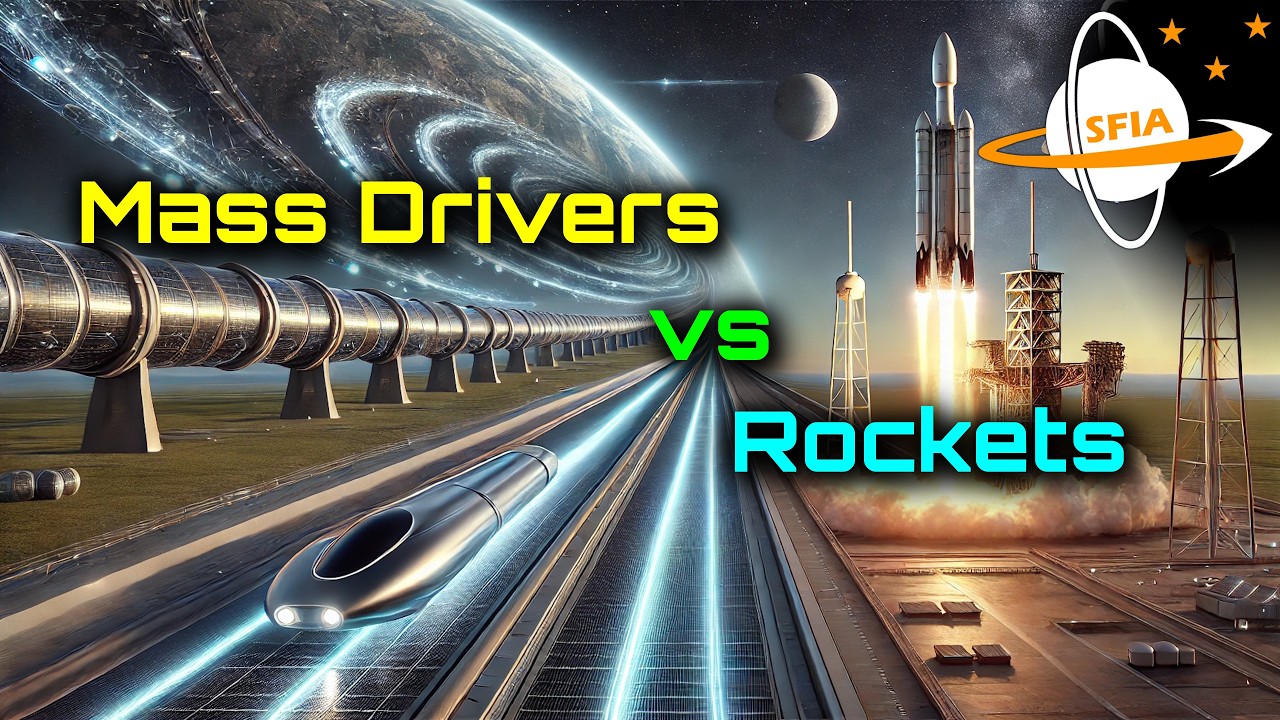
Rockets vs Mass Drivers: Which Will Rule the Skies in the Future?
Keywords
Summary
166 words
Critical Evaluation
Value of the Information & Strength of the Argument
The video provides substantial value by clearly explaining complex physics and engineering concepts in an accessible manner. It uses quantitative examples, such as the rocket equation and cost scaling, to support its arguments. The comparison is balanced, acknowledging the strengths and weaknesses of both technologies. The argumentation is solid, building from basic principles to more advanced concepts, and it effectively uses visual aids and analogies to enhance understanding.
Scientific Rigor, Source Quality, Title Accuracy
The video demonstrates scientific rigor by grounding its explanations in established physics and engineering. It cites specific sources, including a paper on launch technology cost curves and related videos, which adds credibility. The title accurately reflects the content, and the video stays on topic throughout. The inclusion of speculative future concepts is clearly presented as such, maintaining a clear distinction between established science and forward-looking ideas.
149 words
Title / Content Match
The title accurately reflects the content, which systematically compares rockets and mass drivers for future space launch.
Quality & Reliability
8/10
The video provides a well-structured, technically accurate comparison of rockets and mass drivers, grounded in physics and engineering principles. It cites specific sources, including a paper on launch technology cost curves and related videos, and presents quantitative data (e.g., rocket equation, cost scaling). The content is consistent with established scientific knowledge, though it includes speculative future concepts.
Key Moments
Markers derived by PSI from the transcript: the creator did not define chapters.
- Introduction to the comparison between rockets and mass drivers.
- Definition and basic principles of mass drivers.
- Discussion of mass driver characteristics: friction, acceleration, and reaction mass.
- Explanation of rocket propulsion and the rocket equation.
- The tyranny of the rocket equation and fuel requirements.
- Comparison of technology maturity and economic factors.
- Safety and environmental advantages of mass drivers.
- Introduction to the variable pitch screw launcher as a cost-effective mass driver.
- Cost comparison between rockets and mass drivers for various delta-v missions.
- Conclusion on the future roles of rockets and mass drivers.
Cited Sources
- Launch Technology Cost Curves — Referenced as a paper supporting cost analysis of launch technologies.
- How Mass Drivers Enable Geopolitically Significant Achievements in Space Exploration — Related video on mass drivers.
- Why Economics Favors a Mass Driver Over Rockets — Related video on economic comparison.
- Why Physics Favors a Mass Driver Over Heavy Lift Rockets — Related video on physics comparison.
- Isaac Arthur Website — Official website for additional content.
- Nebula - The Fermi Paradox: Air — Promoted exclusive content on Nebula.
- TransPod — Mentioned as a special thanks, likely related to hyperloop technology.
Concurring Sources
- Launch Technology Cost Curves — Supports the cost analysis presented in the video.
External References
Contribution & Novelties
The video provides a comprehensive and accessible comparison of rockets and mass drivers, synthesizing existing knowledge and introducing the variable pitch screw launcher as a novel cost-effective architecture. It offers a clear quantitative framework for comparing launch costs, which is valuable for both enthusiasts and professionals.
Pour aller plus loin :
- Mass driver — Wikipedia article providing background on the concept.
- Rocket equation — Wikipedia article explaining the fundamental equation of rocketry.
- Electromagnetic aircraft launch system — Wikipedia article on EMALS, a real-world application of linear motors.
- Variable pitch screw launcher — Wikipedia article on this specific mass driver concept.
100 words
Radar Profile
The radar profile shows high scores in quantity and quality of information, with a slightly lower but still strong score in technical level and reliability. This indicates a well-researched and informative video that balances depth with accessibility.
💬 Positif. Sur les 30 commentaires analysés, la majorité exprime de l'appréciation pour la clarté des explications et la qualité de l'épisode, avec quelques références humoristiques et culturelles.