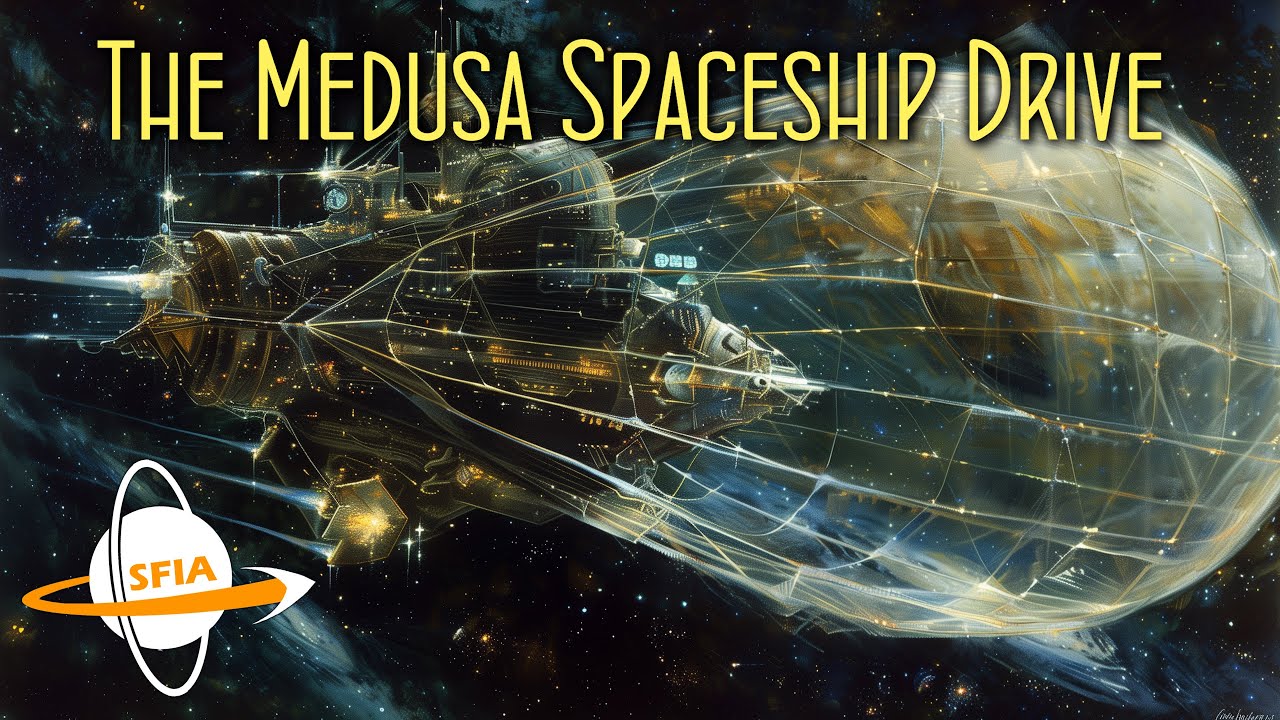
The Medusa Spaceship Drive
Keywords
Summary
182 words
Critical Evaluation
Value of the Information & Strength of the Argument
The video provides substantial technical value by explaining the Medusa drive’s principles, comparing it to Orion, and discussing design trade-offs. The argumentation is solid, grounded in references to original reports and engineering reasoning. The presenter systematically addresses common questions (sail and tether durability) and explores variations (servo winch, different bomb yields). The discussion of advantages (higher efficiency, sail as shield, safer detonation distance) is well-supported. The presentation is balanced, acknowledging limitations and potential risks.
Scientific Rigor, Source Quality, Title Accuracy
The video demonstrates scientific rigor by referencing specific reports (Solem 1991, Dyson 1958) and explaining the physics of momentum transfer. The presenter distinguishes between well-established concepts and more speculative ideas. The title accurately reflects the content. The description provides links to the channel’s website and sponsor, but no direct links to the cited reports, which are mentioned verbally. The video’s technical depth is appropriate for its audience, and the presenter’s expertise is evident.
162 words
Title / Content Match
The title accurately reflects the content, which focuses exclusively on the Medusa drive concept.
Quality & Reliability
8/10
The video provides a detailed and technically accurate overview of the Medusa drive concept, referencing original reports (Solem 1991, Dyson 1958) and discussing engineering trade-offs. The presenter is known for rigorous science communication, and the content aligns with established literature on nuclear pulse propulsion.
Key Moments
Markers derived by PSI from the transcript: the creator did not define chapters.
- Introduction to nuclear propulsion and the Medusa drive concept
- Explanation of why the sail and tethers survive the blasts
- Origin of the name 'Medusa' and historical context (Solem, Dyson)
- Physics of momentum transfer and sail design
- Advantages over Orion: sail as light sail and collision shield
- Spinnaker analogy and sail geometry control
- Specific impulse and bomb yield considerations
- Interstellar applications and tether length benefits
- Interplanetary version and launch from asteroid bases
- Servo winch system for constant acceleration and power generation
- Safety and weaponization concerns, concluding remarks
Cited Sources
- Isaac Arthur website — Channel's official website for additional content.
- 80,000 Hours — Sponsor link, career advice for impactful work.
- Nebula — Streaming platform for Isaac Arthur's content.
- Subscribestar — Support platform for the channel.
- Reddit community — Community discussion forum.
- Epidemic Sound — Music source for the video.
Concurring Sources
- Nuclear pulse propulsion - Wikipedia — General concept aligns with the video's description.
- Project Orion (nuclear propulsion) - Wikipedia — Provides background on the Orion drive, which the video compares to Medusa.
Contribution & Novelties
The video provides a comprehensive and accessible synthesis of the Medusa drive concept, highlighting its advantages over Orion and its potential for interstellar travel. It brings together historical references and modern materials science considerations, offering a balanced view of the concept’s feasibility.
Pour aller plus loin :
- Nuclear pulse propulsion — Overview of the broader category.
- Project Orion (nuclear propulsion) — Historical context and comparison.
- Specific impulse — Definition and relevance to propulsion efficiency.
- Graphene — Material with potential for advanced sail construction.
- Freeman Dyson — Scientist associated with early Orion work.
92 words
Radar Profile
The radar profile shows high scores in quantity of information and technical level, indicating a dense and detailed presentation. The quality and reliability scores are also high, reflecting the presenter's expertise and use of references. The overall profile suggests a content-rich video suitable for an audience interested in advanced space propulsion concepts.
💬 Très positif. Sur les 30 commentaires analysés, la grande majorité exprime un fort enthousiasme pour le sujet et la qualité de la présentation, avec des discussions techniques approfondies et des appréciations sur l'amélioration de la narration.