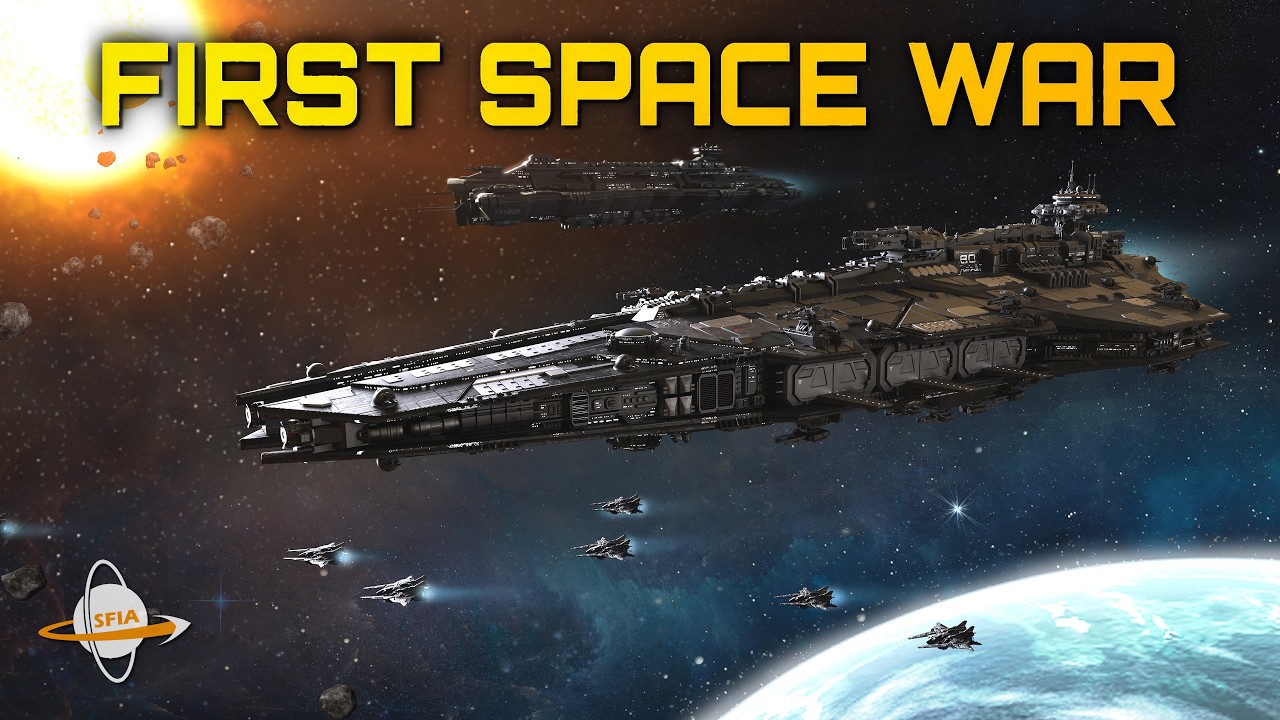
The First Interplanetary War: Tactics in the Solar System
Keywords
Summary
148 words
Critical Evaluation
Value of the Information & Strength of the Argument
The video provides substantial value by deconstructing common science fiction assumptions about space warfare and replacing them with reasoned, physics-based arguments. The argumentation is solid, drawing on principles of orbital mechanics, military history, and human psychology. Arthur effectively uses analogies and thought experiments to illustrate complex concepts, such as the Whipple shield tactic and the strategic implications of fuel constraints. The emphasis on logistics, escalation control, and the political consequences of military actions adds depth and realism. The reasoning is coherent and well-structured, building from the causes of war to the tactical realities and strategic imperatives.
Scientific Rigor, Source Quality, Title Accuracy
The video demonstrates a high level of scientific rigor in its application of physics and engineering principles to a speculative scenario. While it does not cite specific academic sources, the content is consistent with established knowledge in astrodynamics and military strategy. The author’s personal military experience lends credibility to the discussion of warfare and escalation. The title accurately reflects the content, which is a focused analysis of tactics and strategy. The video is well-researched and presents a plausible, if speculative, vision of future conflict.
195 words
Title / Content Match
The title accurately reflects the content, which focuses on the tactical and strategic considerations of a hypothetical first interplanetary war.
Quality & Reliability
8/10
The video presents a well-reasoned, expert-informed analysis of potential interplanetary warfare, grounded in physics and military principles. The author draws on personal military experience and academic background, and the content is internally consistent. However, it is speculative and lacks direct citations to scientific literature, relying on general knowledge and plausible extrapolation.
Key Moments
Markers derived by PSI from the transcript: the creator did not define chapters.
- Definition of interplanetary war: requires populations on different worlds with separate identities.
- Discussion of the first rule of warfare: everything is a potential weapon.
- Escalation control and the dangers of preemptive strikes in a multi-actor solar system.
- The reality of space combat: geometry, probability, and deception over close-range broadsides.
- The Whipple shield tactic and countermeasures like tethered sensor probes.
- Logistics and delta-v as the primary constraints on fleet movement and strategy.
- Asteroid belt warfare: strangulation of infrastructure over annihilation.
- Planetary bombardment is counterproductive; the goal is to win without destroying the prize.
Cited Sources
- Isaac Arthur Website — Official website for the channel and additional resources.
- Nebula (Streaming Platform) — Platform where episodes are available early and ad-free.
- Real Engineering on Nebula — Recommended channel for engineering and reliability analysis.
- Surviving a New Ice Age (Nebula Exclusive) — Exclusive video on how civilizations survive resource scarcity.
- SFIA Reddit Community — Community discussion forum for the channel.
- Subscribestar Support Page — Platform for supporting the channel.
Concurring Sources
- The Expanse (TV series) — Mentioned in comments as a realistic portrayal of interplanetary conflict, aligning with the video's themes.
- Children of a Dead Earth (game) — Mentioned in comments as a realistic simulation of interplanetary combat, supporting the video's technical accuracy.
Contribution & Novelties
The video offers a fresh perspective on space warfare by systematically applying military principles and physics to a realistic interplanetary scenario. It challenges common tropes and provides a nuanced view of conflict, emphasizing the importance of logistics, escalation control, and the political consequences of military actions. The discussion of specific tactics like the Whipple shield and the strategic focus on strangulation over annihilation are particularly insightful.
Pour aller plus loin :
- Delta-v (Wikipedia) — The fundamental measure of spacecraft maneuverability, central to the video’s logistics discussion.
- Whipple shield (Wikipedia) — The real-world concept adapted in the video for offensive deception.
- Mutual assured destruction (Wikipedia) — A concept related to escalation control and the deterrence logic discussed in the video.
119 words
Radar Profile
The radar profile shows strong scores in information quantity and quality, with a slightly lower but still solid technical level and reliability. This indicates a content-rich, well-reasoned video that is accessible to a broad audience while maintaining scientific credibility.
💬 Très positif. Sur les 30 commentaires analysés, le public exprime un fort enthousiasme pour le contenu, appréciant notamment les 'règles de guerre' récurrentes et la profondeur de l'analyse, avec quelques références à d'autres œuvres de science-fiction.