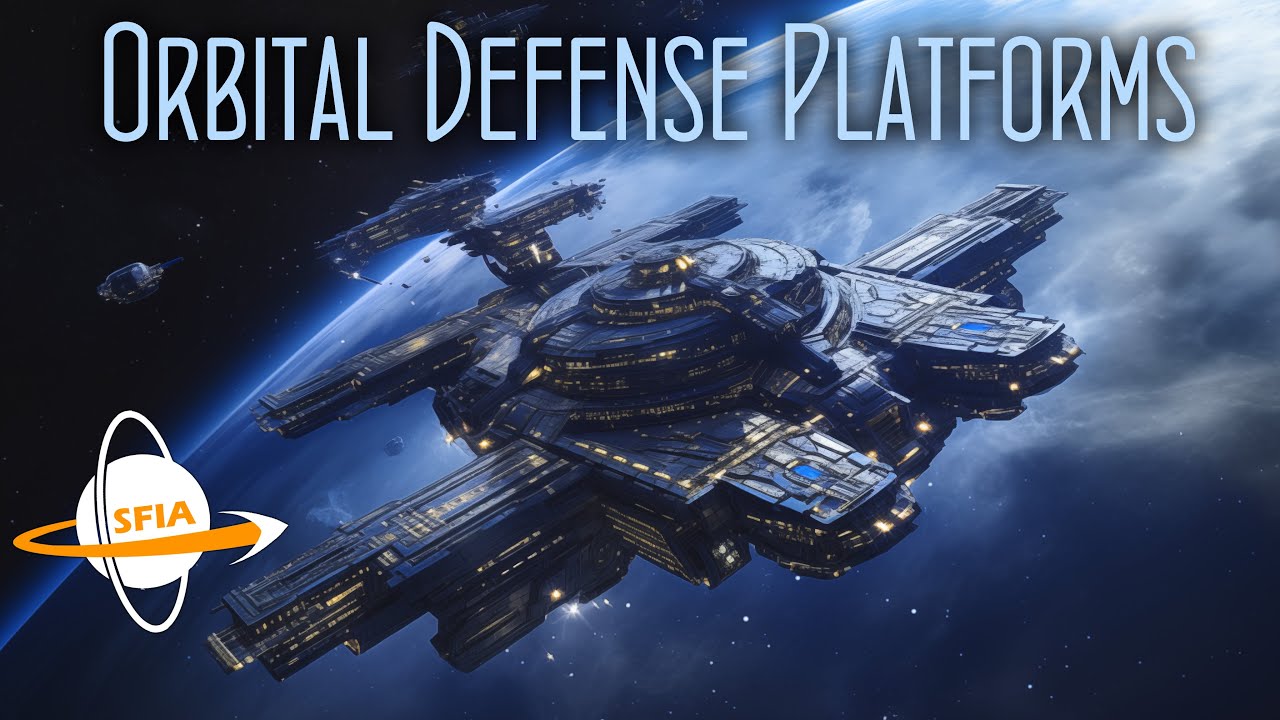
Orbital Defense Platforms
Keywords
Summary
138 words
Critical Evaluation
Value of the Information & Strength of the Argument
The video provides substantial value by systematically deconstructing common sci-fi assumptions about space combat and offering a rigorous, physics-based analysis. Arthur’s argumentation is solid, building from basic principles like light-speed delay and the cube-square law to derive strategic insights. He effectively uses concrete examples, such as the 132-meter uncertainty zone from jinking and the energy of a dime impacting an RKM, to illustrate his points. The reasoning is logical and well-structured, making complex concepts accessible without oversimplifying. The inclusion of counterarguments and alternative scenarios (e.g., tethered formations, non-orbiting towers) strengthens the overall argument.
Scientific Rigor, Source Quality, Title Accuracy
The video demonstrates strong scientific rigor, grounding its analysis in established physics and engineering principles. While it does not cite specific academic papers, it references concepts like the cube-square law and Kessler syndrome, which are well-documented. The title accurately reflects the content, which is a focused exploration of orbital defense platforms. The video’s strength lies in its logical reasoning and clear separation of known physics from speculative future tech. The description provides links to the creator’s website and other platforms, but no direct scientific sources are cited.
195 words
Title / Content Match
The title accurately reflects the content, which focuses on the concept, design, and strategic role of orbital defense platforms.
Quality & Reliability
8/10
The video presents a well-reasoned, physics-based analysis of orbital defense platforms, grounded in known scientific principles (e.g., light-speed lag, cube-square law, relativistic kill vehicles). It clearly distinguishes between science fiction tropes and plausible future technologies, and avoids unsupported claims. The reasoning is internally consistent and acknowledges uncertainties.
Key Moments
Markers derived by PSI from the transcript: the creator did not define chapters.
- Introduction to the topic, referencing Babylon 5 and the concept of orbital defense platforms.
- Discussion of the mobility issue: planets are predictable targets, while ships are mobile but fuel-limited.
- Analysis of engagement ranges and the problem of light-speed lag in targeting.
- Explanation of jinking and its effect on hit probability, using the example of a 3g lateral acceleration.
- Discussion of high-speed flyby attacks and the use of debris and mines as defense.
- Introduction of tether-based maneuvering systems for ships and platforms.
- Exploration of point defense systems, including lasers, flak, and expandable shields.
- Analysis of relativistic kill vehicles (RKMs) and their vulnerability to small debris.
- Discussion of layered defense networks using thin-film shields and pellet clouds.
- Consideration of platform designs, including converted asteroids and space towers.
Cited Sources
- Isaac Arthur's Website — Official website of the creator, providing additional content and information.
- Nebula Video: The Fermi Paradox Hermit Shoplifter Hypothesis — Exclusive video on Nebula, mentioned in the description as related content.
- Epidemic Sound — Music licensing service used for the video's soundtrack.
Concurring Sources
- Halo's Orbital Defense Platforms — Commenters reference Halo's MAC platforms as a similar concept, aligning with the video's ideas.
- Babylon 5's Orbital Defense Platforms — The video itself cites Babylon 5 as an inspiration, and commenters agree on its portrayal.
Dissenting Sources
- Comment on the practicality of orbital platforms — Some commenters question the feasibility of such large structures, but the video addresses these concerns with engineering justifications.
External References
Contribution & Novelties
The video offers a fresh perspective on planetary defense by systematically applying physics to a topic often treated purely as science fiction. It challenges the common trope of vulnerable planets and provides a detailed, plausible framework for orbital defense platforms, including their design, armament, and strategic use. The discussion of RKM vulnerabilities and tether-based maneuvering adds novel insights to the space warfare discourse.
Pour aller plus loin :
- Kessler syndrome — Relevant to the discussion of space debris and its impact on defense.
- Relativistic kill vehicle — Directly related to the analysis of RKM threats and countermeasures.
- Cube-square law — Underpins the discussion of armor and size advantages for large platforms.
111 words
Radar Profile
The radar profile shows high scores in information quantity and quality, indicating a content-rich and well-researched video. The technical level is also high, reflecting the physics-based analysis. The overall reliability is strong, though slightly lower than the other scores, likely due to the speculative nature of the topic.
💬 Très positif. Sur les 30 commentaires analysés, la grande majorité exprime une forte appréciation, saluant la rigueur scientifique et la profondeur de l'analyse, avec des références enthousiastes à des œuvres de science-fiction comme Halo et Babylon 5.