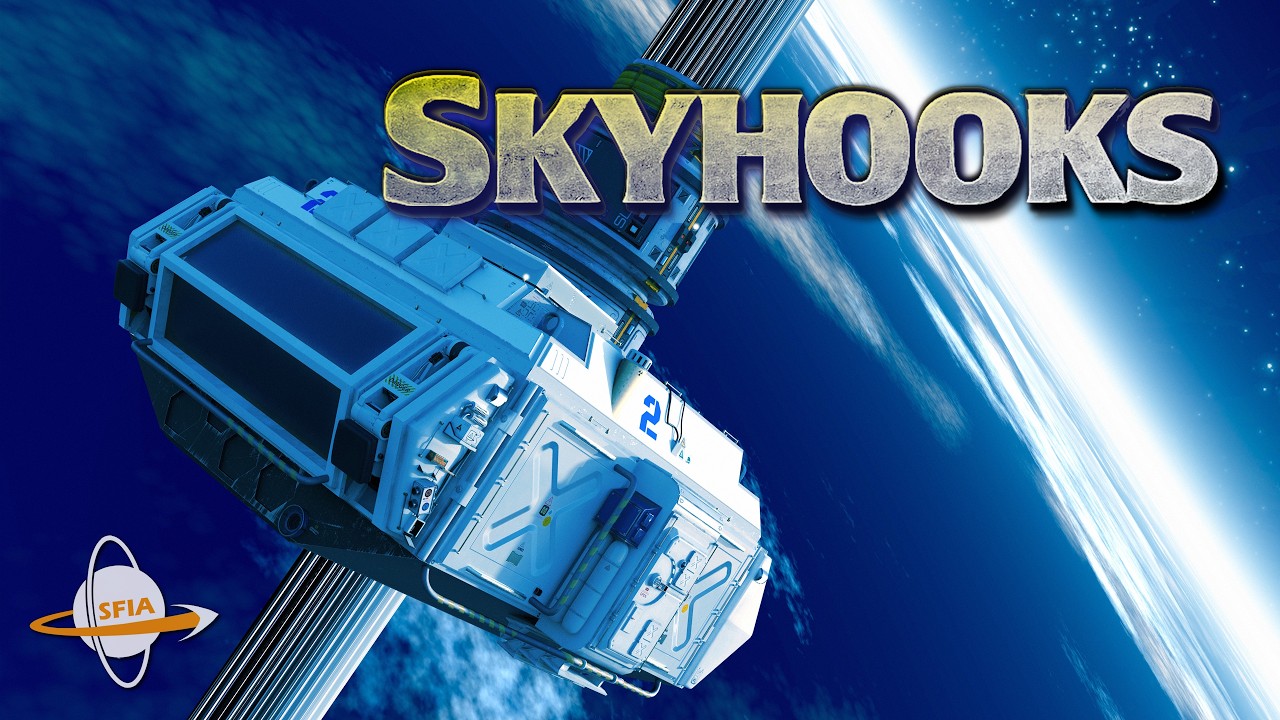
What If We Built A Ladder To Space? Skyhooks & Rotovators
Keywords
Summary
196 words
Critical Evaluation
Value of the Information & Strength of the Argument
The video provides substantial value by clearly explaining the physics and engineering trade-offs of tether-based launch systems. It goes beyond a simple overview, offering quantitative examples (e.g., delta-v reductions, tether lengths, rotation speeds) and comparing different configurations. The argumentation is logically structured, building from basic orbital mechanics to more complex systems, and it acknowledges limitations such as material strength and atmospheric drag. The discussion of momentum regeneration and the potential for synergy with other technologies (mass drivers, spaceplanes) strengthens the practical case. However, the speculative nature of the concepts and the lack of experimental validation mean the arguments are persuasive but not definitive.
Scientific Rigor, Source Quality, Title Accuracy
The video demonstrates scientific rigor by grounding its explanations in established physics (orbital mechanics, rocket equation, Lorentz force) and referencing known concepts and materials (e.g., graphene, Zylon). Isaac Arthur typically cites sources in his videos, though this transcript does not explicitly name specific papers or studies. The title accurately reflects the content, which is a detailed exploration of skyhooks and rotovators. The video is well-researched and consistent with the broader scientific literature on space tethers, though it is presented as a speculative engineering analysis rather than a peer-reviewed study.
207 words
Title / Content Match
The title accurately reflects the content, which explores skyhooks, rotovators, and space ladders as alternatives to rockets for reaching space.
Quality & Reliability
8/10
The video presents a well-structured, technically detailed overview of tether-based launch systems, grounded in established physics and engineering principles. Isaac Arthur is a known science communicator with a track record of accuracy, though the content is speculative and not peer-reviewed. The explanations are consistent with current understanding of orbital mechanics and materials science.
Key Moments
Markers derived by PSI from the transcript: the creator did not define chapters.
- Introduction to tether-based systems and their potential to revolutionize space access.
- Explanation of orbital mechanics and how a skyhook reduces delta-v requirements.
- Discussion of momentum regeneration using ion drives and electrodynamic tethers.
- Introduction to rotovators and their spinning motion, with examples of rotation speeds and effects.
- Comparison of skyhooks and rotovators, including tether stress and rendezvous considerations.
- Exploration of the space ladder concept and its potential for continuous climbing to orbit.
- Discussion of applications on other planets and the broader vision of a spacefaring civilization.
Cited Sources
- Isaac Arthur's Website — Official website for the channel and additional resources.
- Nebula - The End of Science — Promoted exclusive video on Nebula, related to the episode's theme.
- Nebula Subscription — Link to subscribe to Nebula, mentioned in the video.
- Nebula Lifetime Membership — Link for lifetime membership, mentioned in the video.
- Reddit Community — Community discussion forum for the channel.
- Subscribestar — Alternative support platform for the creator.
- Epidemic Sound — Music licensing service used for the video's soundtrack.
Concurring Sources
- Space Elevator Concept — The video builds on the space elevator concept, which is well-documented in scientific literature.
- Electrodynamic tether — The video discusses electrodynamic tethers for momentum regeneration, a concept with experimental validation.
Dissenting Sources
- Material strength limitations — The video assumes graphene super-laminate (GSL) with a breaking length of 4200 km, but current graphene production at scale is not yet proven, and some experts argue that even GSL may not be sufficient for a full space elevator, though shorter tethers are more feasible.
Contribution & Novelties
This video provides a comprehensive and accessible synthesis of tether-based launch concepts, clarifying the terminology and technical distinctions between skyhooks and rotovators. It offers quantitative examples and practical considerations, such as momentum regeneration and atmospheric drag, which are often glossed over in popular discussions. The video also connects these concepts to broader space infrastructure ideas, like orbital rings and space ladders, and discusses their potential on other planets.
Pour aller plus loin :
- Space tether — Wikipedia article providing background on tether physics and applications.
- Orbital ring — Wikipedia article on the concept of a ring around a planet for space access.
- Rocket equation — Wikipedia article explaining the exponential relationship between delta-v and fuel mass, central to the video’s argument.
121 words
Radar Profile
The radar profile shows high scores in information quantity and technical level, indicating a dense and detailed presentation. The quality and reliability scores are also strong, reflecting the video's grounding in physics and engineering. The overall profile suggests a content that is both informative and technically rigorous, suitable for an audience interested in advanced space concepts.
💬 Très positif. Sur les 30 commentaires analysés, la grande majorité exprime une forte appréciation pour la qualité du contenu, la clarté des explications et la régularité des publications, avec quelques suggestions d'amélioration et des références à des œuvres de science-fiction.