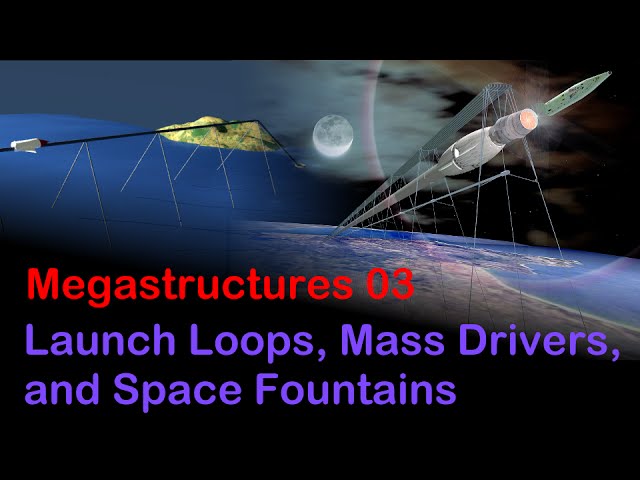
Launch Loops, Mass Drivers, and Space Fountains
Keywords
Summary
137 words
Critical Evaluation
Value of the Information & Strength of the Argument
The video provides a high-level but substantive overview of non-rocket launch systems, explaining the underlying physics and engineering trade-offs. It argues convincingly that such systems could drastically reduce launch costs, citing the inverse square relationship between track length and acceleration, and the potential for skyhooks to shorten required track lengths. The argumentation is logical and well-structured, though it relies on qualitative explanations rather than detailed quantitative analysis. The video also addresses common misconceptions, such as the energy storage in launch loops, and provides a balanced view of the challenges involved.
Scientific Rigor, Source Quality, Title Accuracy
The video demonstrates scientific rigor by grounding its explanations in established physics and engineering principles. It references the Lofstrom Loop paper and StarTram’s website, which are credible sources. The title accurately reflects the content, and the video stays on topic. The presentation is clear and avoids overstatement, though it could benefit from more citations to peer-reviewed literature. The video is part of a well-regarded series known for its thoughtful exploration of futuristic concepts.
178 words
Title / Content Match
The title accurately reflects the content, which covers launch loops, mass drivers, and space fountains as promised.
Quality & Reliability
8/10
The video provides a clear and accurate overview of non-rocket launch systems, grounded in established physics and engineering concepts. It correctly explains the rocket equation, acceleration, and the principles behind launch loops, mass drivers, and space fountains. The content is well-structured and avoids sensationalism, though it lacks detailed mathematical derivations and peer-reviewed sources.
Key Moments
Markers derived by PSI from the transcript: the creator did not define chapters.
- Introduction to the episode and overview of non-rocket launch systems.
- Explanation of the Lofstrom Loop concept, including its structure and operation.
- Discussion of the physics of acceleration and track length, including the inverse square relationship.
- Introduction to mass drivers and their applications for cargo.
- Detailed look at StarTram, including Generation 1 and 1.5 designs.
- Discussion of plasma windows and the challenges of exiting a vacuum tube.
- Introduction to space fountains and their potential uses.
- Conclusion and summary of the episode.
Cited Sources
- Launch Loop Paper — Referenced as the source for the Lofstrom Loop design.
- StarTram's website & proposals — Referenced as the source for StarTram concepts.
- Isaac Arthur's Website — Mentioned as the channel's official website.
- Nebula — Mentioned as a platform for the channel.
- Reddit Community — Mentioned as a community forum.
- Subscribestar — Mentioned as a support platform.
Concurring Sources
- Launch Loop Paper — The video's description of the Lofstrom Loop aligns with the technical details in this paper.
- StarTram's website & proposals — The video's description of StarTram matches the information on the official website.
Contribution & Novelties
The video provides a clear and accessible synthesis of non-rocket launch concepts, highlighting their potential to reduce launch costs and enable megastructure construction. It effectively explains the trade-offs between acceleration, track length, and human tolerance, and introduces the concept of space fountains as versatile support structures.
Pour aller plus loin :
- Lofstrom Launch Loop — Wikipedia article providing additional details on the concept.
- Mass driver — Wikipedia article on mass drivers and their applications.
- Space fountain — Wikipedia article on space fountains and their mechanics.
- Skyhook (structure) — Wikipedia article on skyhooks, which are mentioned in the video as complementary systems.
101 words
Radar Profile
The radar profile shows high scores in information quantity, quality, and reliability, with a slightly lower technical level. This indicates a well-researched and informative video that is accessible to a broad audience, though it may not delve deeply into advanced mathematical or engineering details.
💬 Très positif. Sur les 30 commentaires analysés, les spectateurs expriment une admiration générale pour la clarté et la profondeur du contenu, certains demandant plus de détails mathématiques, mais sans critique négative notable.