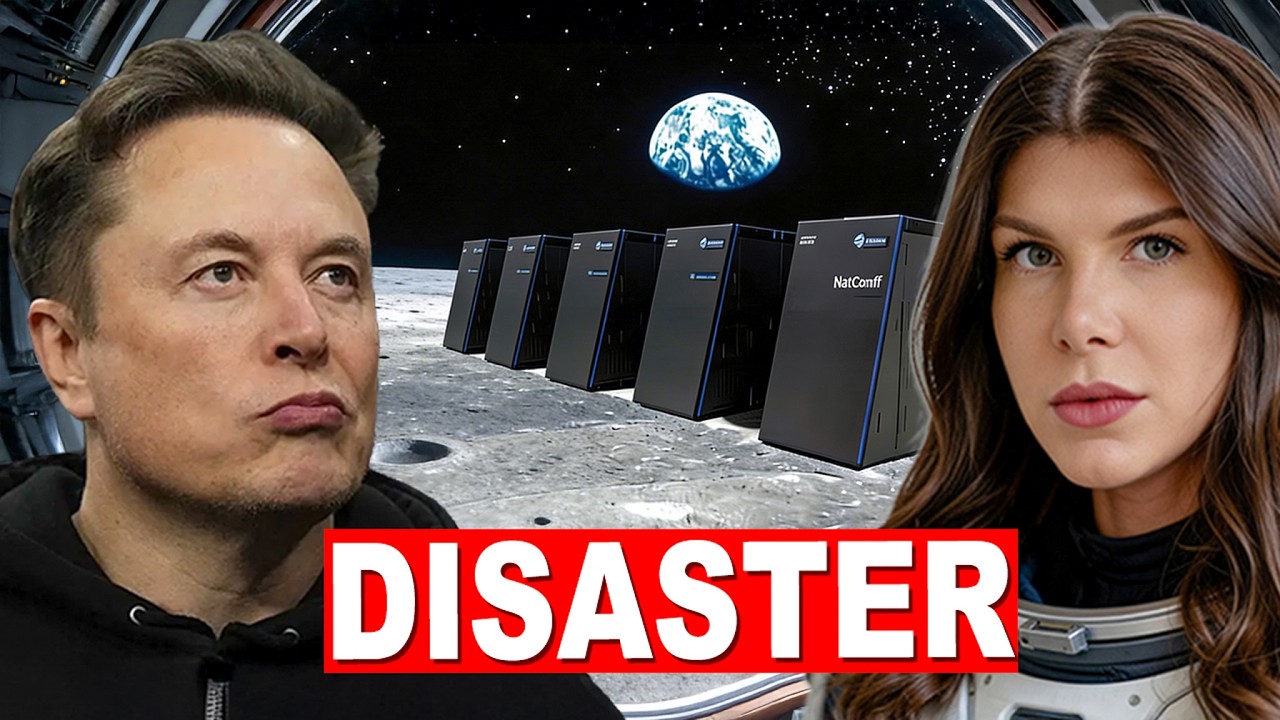
The Killer Behind Data Centers In Space — Note de synthèse
Note de synthèse · Post Singularity Institute
The Killer Behind Data Centers In Space
par Anastasi In Tech
🎙️ Anastasi In Tech👥 490K📅 February 27, 2026⏱ 29 min👁 425K🔬 Engineering & Technology
Keywords
orbital data centerradiative coolingfree-space opticsradiation hardeninglunar base
Summary
The video explores the feasibility of placing AI data centers in orbit and on the Moon, driven by Earth's constraints on power, land, and cooling. It details the engineering hurdles: radiation damage to chips, massive solar arrays for 40 MW, radiative cooling requiring huge radiators (120,000 m²), extreme temperature swings, and bandwidth bottlenecks via laser links. The presenter argues that while power is solvable, cooling and data transmission are critical. Maintenance is addressed through redundancy and replacement, similar to Starlink. The Moon is considered for larger scales but introduces latency and construction challenges. The video concludes that space data centers are technically possible but economically daunting, with launch costs and thermal management as primary obstacles.
Critical Evaluation
The video presents a well-structured, technically grounded analysis of orbital and lunar data centers, a topic gaining traction among tech giants. The presenter, with a background in microchip design, effectively communicates complex physics (Stefan-Boltzmann law, radiative cooling) and engineering trade-offs. The argument is balanced: it acknowledges the appeal of unlimited solar power and land while systematically dismantling the fantasy with real constraints. The use of specific numbers (40 MW, 120,000 m² radiators, 400-800 tons) adds credibility, though these are estimates based on standard spacecraft assumptions rather than verified designs. The discussion of radiation hardening and free-space optics is accurate, referencing existing technologies like Starlink's laser links. However, the video lacks citations to peer-reviewed studies or official project documents; it relies on the presenter's expertise and general knowledge. The sponsorship by IEEE Spectrum is disclosed, but the promotional segment interrupts the flow. The title is representative, focusing on the 'killer' problem (cooling and bandwidth). The video does not address alternative solutions like edge computing or terrestrial efficiency improvements, which could mitigate the need for space data centers. Overall, it is a valuable thought experiment for technically literate audiences, but it should be viewed as expert opinion rather than rigorous scientific analysis.
The video provides a comprehensive, accessible breakdown of the engineering challenges specific to space-based AI data centers, particularly the dominance of thermal management and bandwidth limitations. It synthesizes concepts from satellite technology, radiative heat transfer, and high-performance computing into a coherent feasibility analysis. While the idea is not new, the detailed quantification of radiator area and launch costs offers a concrete perspective.
Pour mieux comprendre :
- Radiative cooling — Explains the Stefan-Boltzmann law and its application in space thermal control.
- Free-space optical communication — Describes laser communication principles and atmospheric challenges.
- Radiation hardening — Covers techniques to protect electronics from space radiation.
Radar Profile
The radar chart shows high scores in information quantity and technical level, reflecting the video's depth and specificity. Quality and reliability are moderate due to lack of peer-reviewed sources and reliance on expert opinion. The profile indicates a technically informative but not rigorously scientific presentation.