cosmic calendaruniverse timelineBig Bangstellar evolutionEarth history
Summary
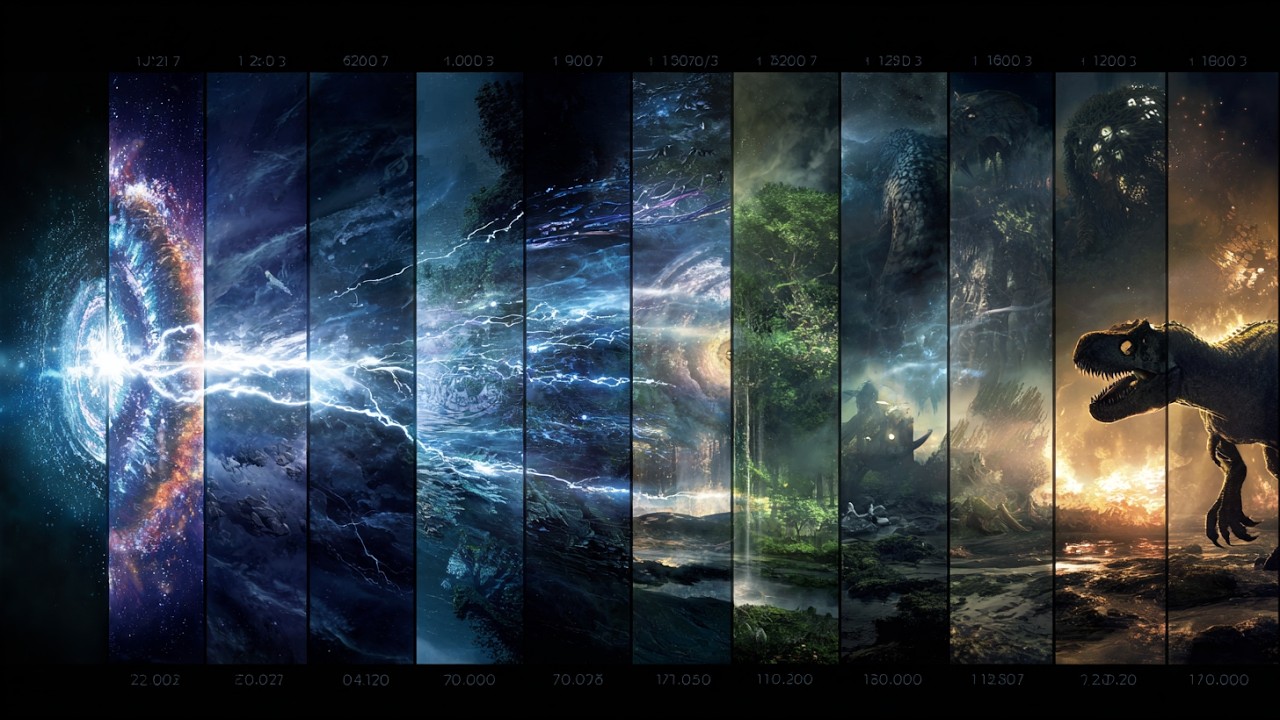
This video presents the entire history of the universe compressed into a single year, known as the cosmic calendar. It starts with the Big Bang on January 1 and ends with the present moment on December 31 at midnight. The narrative covers key events such as the formation of the first stars and galaxies, the birth of the Milky Way, the formation of the solar system and Earth, the emergence of life, the evolution of complex organisms, and the rise of humans. It also looks ahead to the future of the universe, including the death of the Sun and the eventual end of life on Earth. The video uses vivid imagery and analogies to make vast timescales comprehensible, and it includes a sponsored segment for an AI tool called Mammouth. The content is scientifically accurate in its broad strokes, though some details are simplified for a general audience.
Critical Evaluation
The video 'La folle histoire de l’Univers en 365 jours' by Balade Mentale is an ambitious and visually engaging attempt to condense 13.8 billion years of cosmic history into a 54-minute documentary. The central concept—the cosmic calendar—is a well-known pedagogical tool popularized by Carl Sagan, and the video executes it effectively, using clear timelines and striking animations to illustrate the relative timing of major events. The narrative flows logically from the Big Bang through the formation of galaxies, stars, planets, life, and human civilization, and even ventures into speculative future scenarios. The scientific content is generally accurate and up-to-date, covering topics such as the cosmic microwave background, galaxy formation, stellar nucleosynthesis, planetary formation, the Great Oxidation Event, the Cambrian explosion, and mass extinctions. However, the video has several limitations. First, it lacks explicit citations for many of its claims; while the overall narrative is consistent with mainstream science, specific figures (e.g., the exact timing of events in the cosmic calendar) are presented without references. The only external link provided is to mammouth.ai, a commercial AI service, which is promoted within the video. This promotional segment, while clearly marked as a sponsorship, interrupts the scientific narrative and may raise questions about objectivity. Second, the video simplifies complex processes, which is inevitable given the format, but occasionally glosses over uncertainties or alternative hypotheses. For example, the formation of the Moon via a giant impact is presented as fact, though it remains the leading hypothesis. The description of the Cambrian explosion as a sudden burst of life is accurate but could be nuanced with more recent research suggesting a longer fuse. Third, the video's treatment of human evolution is brief and somewhat teleological, implying a linear progression from hominids to Homo sapiens without addressing the branching nature of our family tree. The final sections on the future of the universe are speculative but grounded in known astrophysical processes, such as the Sun's eventual red giant phase and the heat death of the universe. Overall, the video is a valuable educational resource for a general audience, but it should be supplemented with more detailed and cited sources for deeper understanding. The title is representative of the content, and the video's strengths in communication and visual storytelling outweigh its minor scientific simplifications.
The video offers a visually compelling and accessible overview of cosmic history using the cosmic calendar framework. While the concept is not original, the video's production quality, clear narration, and comprehensive timeline from the Big Bang to the far future provide a valuable educational resource for the general public. It effectively conveys the immense timescales involved and the interconnectedness of cosmic and biological evolution.
Pour mieux comprendre :
- Cosmic Calendar (Wikipedia) — This Wikipedia article explains the cosmic calendar concept popularized by Carl Sagan, providing a detailed breakdown of events and their corresponding dates.
- Timeline of the Universe (Wikipedia) — A comprehensive timeline of the universe from the Big Bang to the present, with scientific explanations for each major epoch.
- History of Earth (Wikipedia) — This article covers the geological and biological history of Earth, including the formation of the planet, the emergence of life, and major evolutionary events.
Radar Profile
The radar profile shows high scores in quantity of information and fiabilite globale, reflecting the video's comprehensive coverage and generally accurate science. The quality of information and niveau technique are slightly lower due to simplifications and lack of citations. Overall, the video is a strong educational tool but not a rigorous scientific source.