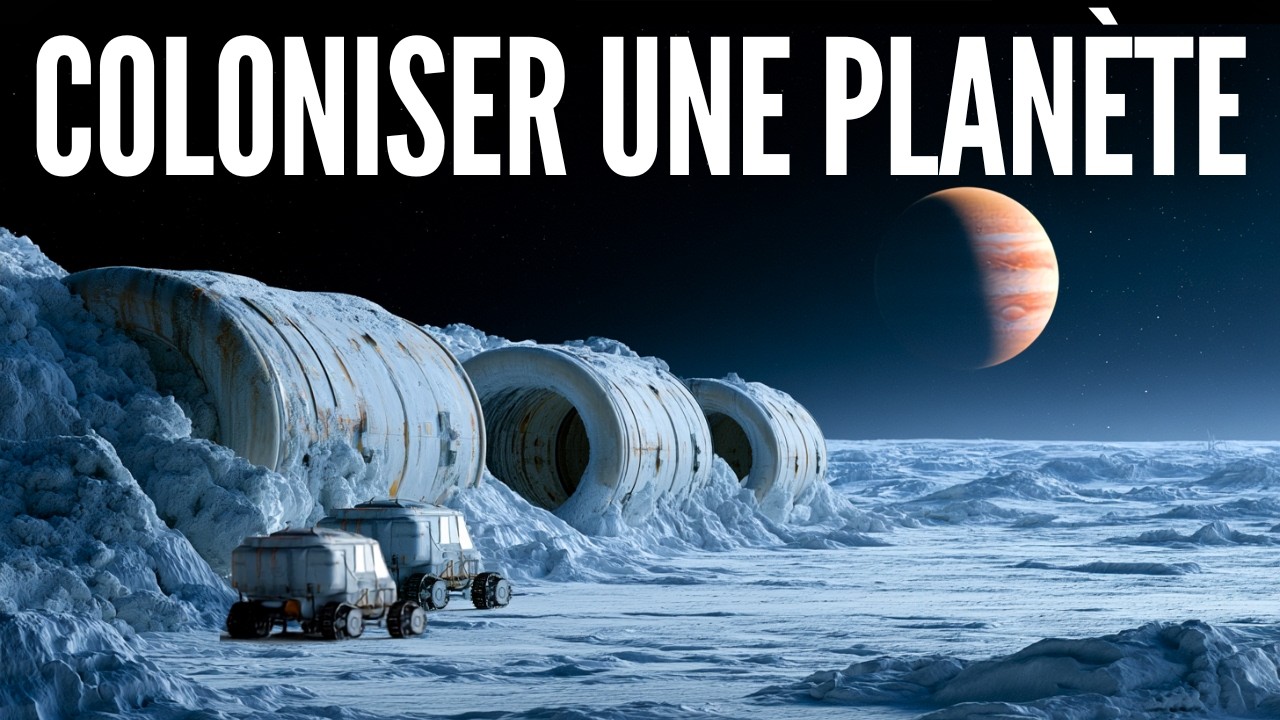
This video explores which celestial body in the solar system would be most suitable for a first human base, emphasizing that 'hospitable' means survivable with technology, not comfortable. It systematically reviews the Moon, Mercury, Venus, Mars, and outer planet moons (Europa, Enceladus, Titan), highlighting each world's key resources and extreme challenges. The Moon is presented as a training ground due to proximity, despite its lack of atmosphere and water. Mercury offers abundant solar energy but no protection. Venus has a hellish surface with high pressure and temperature, though its upper atmosphere might be more benign. Mars is the most Earth-like but cold, dry, and irradiated. The icy moons of Jupiter and Saturn may harbor subsurface oceans but are far and hostile. The video concludes that Earth remains the only truly hospitable planet, and exploring these worlds teaches us to appreciate our own. It also includes a sponsored segment for Mammouth AI, an AI platform aggregator.
Critical Evaluation
The video provides a comprehensive and engaging overview of planetary habitability, suitable for a general audience interested in space exploration. The presenter, Christophe Pauly, adopts a clear narrative structure, moving from the Moon outward and comparing each world's potential for human settlement. The scientific content is generally accurate: the discussion of Venus's runaway greenhouse effect, the importance of water for life support and fuel, and the challenges of radiation on Mars are all well-founded. The use of deuterium-to-hydrogen ratios as a tracer of past water loss is a nice touch, reflecting real planetary science methods. However, the video lacks explicit citations for many specific claims (e.g., exact temperatures, pressures, or mission details). While the description includes links to a NASA technical paper and a book, these are not directly referenced in the narration. The sponsored segment for Mammouth AI is clearly demarcated and does not interfere with the scientific content. The video's strength lies in its synthesis of known facts rather than presenting new research. It does not delve into controversial topics or alternative viewpoints, which is appropriate for its explanatory nature. The title is representative of the content, though slightly dramatic. The chapter markers are helpful for navigation. Overall, the video is a reliable piece of science communication, but viewers seeking deeper technical details or primary sources would need to consult additional materials. The analysis of comments is not possible as they are not provided. The video's main limitation is its lack of depth on certain topics, such as the engineering challenges of building habitats or the specific resource extraction methods. Nonetheless, it successfully conveys the key message that space is extremely hostile and that Earth is uniquely suited for human life.
The video synthesizes known information about planetary habitability into a coherent narrative aimed at a general audience. Its original contribution is not in new scientific findings but in framing the comparative analysis around the concept of 'hospitality' as a combination of resources and protection. It effectively communicates why Earth is uniquely suited for human life and why other worlds require extensive technological support.
Pour mieux comprendre :
- Planetary habitability — Wikipedia article providing an overview of factors that make a planet suitable for life.
- Water on the Moon — Wikipedia article detailing the presence and distribution of water ice on the Moon.
- Venusian atmosphere — Wikipedia article describing the composition, pressure, and temperature of Venus's atmosphere.
Radar Profile
The radar profile shows balanced scores across quantity, quality, technical level, and reliability, all around 6-7 out of 10. This indicates a solid, accessible science communication piece that is neither overly simplistic nor highly technical. The video excels in clarity and structure but lacks depth in citations and novel insights.